Pages

Subscribe:

Ads 468x60px

Showing posts with label Automotive Technology. Show all posts

Friday, February 3, 2012

A 'natural' solution for transportation

Argonne National Laboratory
Feb 2, 2012
Researchers at Argonne have begun to investigate adding one more contender to the list of possible energy sources for light-duty cars and trucks: compressed natural gas (CNG). Image courtesy of Mercedes Benz

As the United States transitions away from a primarily petroleum-based transportation industry, a number of different alternative fuel sources—ethanol, biodiesel, electricity and hydrogen—have each shown their own promise. Hoping to expand the pool even further, researchers at the U.S. Department of Energy's Argonne National Laboratory have begun to investigate adding one more contender to the list of possible energy sources for light-duty cars and trucks: compressed natural gas (CNG).

Compressed natural gas is composed primarily of methane, which when compressed occupies less than one percent of the volume it occupies at standard pressure. CNG is typically stored in cylindrical tanks that would be carried onboard the vehicles it fuels.

Because the domestic production of natural gas has increased dramatically over the past ten years, making a large number of the cars and light trucks currently on the road CNG-compatible would help to improve U.S. energy security. "As a country, we don't lack for natural gas deposits," said Argonne mechanical engineer Thomas Wallner. "There are fewer obvious challenges with direct supply than with most other fuels."

Natural gas currently comes primarily from deep underground rock structures, including shale. Recent improvements with hydraulic fracturing, or "fracking," a controversial process that some critics claim can hurt the environment, have made it economical for natural gas companies to extract a greater supply of natural gas from unconventional sources.

Like gasoline, both the production and combustion of CNG release greenhouse gases into the atmosphere. To be able to make an accurate comparison to gasoline, scientists and engineers will need to look at each stage of the fuel's production and use, said Argonne environmental scientist Andrew Burnham.
To read more click here...

Monday, January 30, 2012

New Capabilities of today’s Automotive Glass Equipment

Engineerblogger
Jan 30, 2012


Today’s know-how, together with new developments in control technology and machine production technologies allow to utilise automotive glass grinding and cutting machines in new ways.

This equipment with its more flexible use, can reach higher quality and/or much shorter cycle times as well as it is open for new applications.

New equipment with direct drive technology is able to preprocess glass in a higher quality and at the same time faster than in the past. Thanks to the drives the gearboxes can be eliminated, higher torque can be achieved and higher resolution encoders can be used. Eliminating the gearboxes menas eliminating the mechanical play totally. The accuracy is given by the measurement system and the performance of the drive regulator. The measurement systems can resolve down to micrometers or micronarcs for polar systems.

Using the new technology the customers do not have to decide between productivity and quality to a given price. The new controls allow to adapt the production quality to the desired level. For example a customer can start its venture in the less demanding replacement segment, where high output is critical. If he is looking for new opportunities later it is possible to reprogram the machine to the highest quality levels. The customer is able to compete on the highest quality levels which allow asking for a higher price for the manufactured product. Todays new electronic developments allow an easy and riskless adaption of parameters. The technology, accuracy and flexibility can be applied in other glass production fields like solar or architectural production as well.


Technical basis of champ’speed
Working with two cutting bridges allows to separate relief cuts and form cuts. Furthermore the customer can separate cutting and breaking if needed. Using the correct combination distributing the processes allows moving the bottleneck process in cutting and grinding from the cutting/breaking into the grinding operation. The best combination depends on the design of the end product. In most of the cases the best solution is to do the relieve cuts on the first station and the cutting and breaking on the second station. Having two independent cutting heads with one breaking ball head gives room for the very best possible combination to increase the quality and accuracy to the maximum with the lowest possible cycle time.


Figure 1: Example windscreen

Producing a form with an accuracy of 100 percent is possible but physical parameters limit the cycle time. If needed, the machine can follow the contour exactly. This will result in a very accurate glass, but takes its time. In theory, the relation between grinding speed and forward movement should be constant. To reach a constant grinding surface the speed has to be reduced at each point where the grinding spindle makes a turn or goes around an edge. This means: the smaller the radius, the lower the speed. As the grinding wheel has a diameter, the speed of its centre point has to increase, because it has to travel a much longer way than the grinding point of the glass. In an inner arc, the travelling speed has to be reduced, because otherwise the wheel would take too much glass and will get choked.

Today there are two ways, to achieve high speed and accuracy. Firstly it is possible to make the design of the form in a way that the end result will still be in specs. This means that the design is not in the middle of the tolerance field designed, but will touch the limits with working in lower tolerance bands. The achieved result is still the same (faster production cycle, in given tolerance), but the result does not depend on factors like speed or grinding wheel diameters anymore. Secondly one can do the same like in the past i.e. opening the contour error and allow bigger deviation. But with these methods the resulting form will then depend again on process parameters like speed. This method is not recommended but is very easy to do and does not require additional know-how or skill, but the production cycle improvement can still be considerable.


Figure 2: Cutting path with new equipment can increase corner speeds, improve quality and is reproducible

Additional to the improvement in cycle time due to the higher moment of the motor, a well designed grinding path can add considerable cycle time advantages. Together with using two bridge cutting and direct drive grinders, the cycle time can come from 27 seconds for a windshield down to 16 seconds, for the same design.

Higher torque and higher accuracy allow on polar machine to increase the diameter range. Not only windshields for trucks and busses but also solar glasses or other high end glass with diagonals up to 3.6m are possible to grind with accuracies below 0.1mm around the whole circumference. This accuracy can be achieved with low cost process due to low cycle times, automotive approved equipment and low cost consumables.
 
Figure 3: Trajectory speed of the grinding wheel center

Commercial applications
The investment is not much different than in the past, but the cycle times improve a lot on the same production space. This alone can justify a replacement of machines. Higher torque motors allow running the grinders faster and more accurate. Adding the possibility to use the tolerance band in improving cycle time gives more flexibility. The decision to invest in accurate or fast equipment has not to be taken anymore. The equipment can be bought and during the time of use switched by parameters to either use the machine in a mode with very low tolerances or in a mode with very high precision.

A company can start of in producing replacement glass with very high output and low cost for example and switch for other projects to OEM manufacturing parameters with high machine and process capabilities and insuring six sigma tolerances or more. The characteristic of the equipment can cater for different markets and customers by simply pushing a button or by an intelligent design. Using this way also small companies can invest and be sure, that the equipment keeps its value for all future ventures and supports future expansions. For solar glass new dimensions of accuracy can be achieved by low costs. The flexibility is there to adjust in the future to all needs of forms or accuracy. Proven process capabilities are given out of the automotive industry.

With this equipment producing changing models is possible without making test glasses. It is possible to change from one model to the next, without wasting one glass and without tweaking parameters. Change over time is dramatically reduced and lower skilled personal can handle the machines.

Figure 4: Example of a new automotive glass preprocessing equipment – champ’speed-line of Bystronic glass

Conclusion – Limitations and things to consider
Due to the fact, that the machine does what the program defines, it means that a form has to be defined 100% correctly. The machine follows the drawing exactly. The CAD-drawing must include all detail and the transition from one drawing element to the next. Transitions of elements have to be correct and tangents have to be handled with care and accuracy. This higher demand in designing capabilities might allow to reduce the capabilities of the machine operator.

About Bystronic Glass
Bystronic glass is the most competent and reliable partner for services, machinery, plants and systems in the glass processing sector. Bystronic glass supplies its well-proven machine technologies also in important areas of the photovoltaic industry. This includes preprocessing, front-end and back-end solutions. Bystronic glass is an international brand with globally operating companies that support their customers on site and through own sales and service companies. Since 1994, Bystronic glass is part of the Conzzeta AG, a renowned Swiss industrial holding company.

Source: Glass on Web


Additional Information:

Tuesday, January 24, 2012

Europe's Driverless Car : semi-autonomous BMW car being demonstrated on a German autobahn

Technology Review
Jan 24, 2012
Easy ride: A semi-autonomous BMW car being demonstrated on a German autobahn. It can accelerate, brake, and overtake slower vehicles on its own. Credit: BMW

Tucked away in the basement of an iconic office tower shaped like four engine cylinders, engineer Werner Huber is telling me about the joy of driving. We're here at BMW headquarters, in Munich, Germany—capital of Bavaria, and arguably of driving itself. But Huber oversees strategic planning for advanced driver assistance systems, so in a way, his job is to put an end to driving—at least as we know it.

"I think that in 10 to 15 years, it could be another world," Huber says. He's not willing to predict exactly what driving will look like then, but he's certain humans will be doing a lot less of it.

For many people, automated cars call to mind those high-tech vehicles with a rotating periscope on top that Google has been driving around California. But Huber and executives at other European automakers say the automated driving revolution is already here: new safety and convenience technologies are beginning to act as "copilots," automating tedious or difficult driving tasks such as parallel parking.

"Driverless" technology will initially require a driver. And it will creep into everyday use much as airbags did: first as an expensive option in luxury cars, but eventually as a safety feature required by governments. "The evolutionary approach is from comfort systems to safety systems to automatic driving," says Jürgen Leohold, executive director for research at Volkswagen Group in Wolfsburg, Germany.

Both BMW and Volkswagen are among the companies already demonstrating cars that drive themselves. In 2010, Volkswagen sent a driverless Audi TTS up Pike's Peak at close to race speeds. Like similar vehicles from Google, these automated vehicles use some combination of GPS, radar, lasers, ultrasonic sensors, and optical cameras to create a constantly updated, 360-degree model of the surrounding environment, which an in-car computer can use to navigate.

But European automakers say their strategy is to move toward greater levels of autonomy incrementally, depending on what does well in showrooms.

Buyers of European luxury cars are already choosing from a menu of advanced options. For example, for $1,350, people who purchase BMW's 535i xDrive sedan in the United States can opt for a "driver assistance package" that includes radar to detect vehicles in the car's blind spot. For another $2,600, BMW will install "night vision with pedestrian detection," which uses a forward-facing infrared camera to spot people in the road.

Lasers, cameras, and other sensors are the most expensive part of autonomous driving systems. Some experimental self-driving cars are estimated to carry more than $200,000 worth of cameras and other gear. Those costs are also leading automakers toward a gradual approach that starts with sensor technologies and then extends capabilities to control driving tasks as well. In the high-end Mercedes-Benz CL, for instance, cameras not only tell a driver when he or she is leaving the lane but actually help the vehicle steer itself back. Several automakers already sell cars with so-called adaptive cruise control that automatically applies the brakes during highway driving if traffic slows. Next, BMW plans to extend that idea in its upcoming i3 series of electric cars, whose traffic-jam feature will let the car accelerate, decelerate, and steer by itself at speeds of up to 25 miles per hour—as long as the driver leaves a hand on the wheel.
To read more click here...


Related Article:


Monday, January 23, 2012

Modified Toyota 2000GT Solar EV

Engineerblogger
Jan 23, 2012


Modified Toyota 2000GT Solar EV


Toyota have developed a solar EV based on the 2000GT, its classic limited production grand tourer.

"There is a solar panel on the hood and a translucent solar panel on the rear window. Solar panels still have low charging efficiency, so they need about two weeks to charge fully from zero. But we've been particular about utilizing solar panels, to power this car without using any electricity from thermal plants, or emitting any CO2."

This car was built by the Toyota Automobile Association, which includes dealers, parts suppliers, and engineers as well as Toyota itself. It incorporates both traditional Japanese craftsmanship and cutting-edge technology.

This car was converted by members of the Crazy Car Project, which includes engineers from car dealers, parts suppliers, and car makers. It incorporates both traditional Japanese craftsmanship and cutting-edge technology.

"We created the interior together with a company called Hayashi Telempu, which supplied parts for the original 2000GT. The idea was to revive the original features using today's technology. By using artificial leather instead of real leather, we've given the interior an even smoother finish. For the wooden finish on the instrument panel, rather than the original brown, we've used Japanese black lacquer, with gold and silver accents. This was commissioned from artisans in Kaga, to create a traditional Japanese atmosphere. Another highlight is the seven-dial meter, a characteristic feature of the original 2000GT. We've kept the original arrangement unchanged, but now it shows EV readings, like the motor rate, battery charge, and battery temperature."

This concept behind this vehicle is a solar car that can carry two people at a top speed of 200 km/h. It has a 35 kWh battery from Panasonic, and uses the motor and inverter from the Lexus LS Hybrid.

"The sound of a gasoline engine in a race is exciting, and with a quiet EV, you can add the kind of sound you like. By making the pitch and frequency vary linearly when the accelerator is pressed, we've created a sound that simulates a race car very well."

"Imagine a parking lot in summer. The parking lot here in midsummer is full of cars, and they're not doing anything useful, just getting hot in the sun. If all cars had solar panels like this, they'd make a great mega-solar plant. If that could be achieved, automobiles, which are said to be unfriendly to the environment, could become good for it. They'd be useful even when they were parked. We've built this car in the hope that, one day, the world will be like that."


Source: DigInfo TV

Additional Information:

Wednesday, January 18, 2012

China's drive for 'green' cars hits roadblocks

Engineerblogger
Jan 18, 2012


A man looks at a Volvo V60 electric car displayed at the Shanghai Auto Show in Shanghai last April. Car makers are struggling to sell environmentally friendly vehicles in China, even as Beijing pumps billions into clean energy.


Foreign and domestic car makers are struggling to sell environmentally friendly vehicles in China, the world's largest auto market, even as Beijing pumps billions into clean energy.


China wants five million "new energy" vehicles on the streets by 2020 to ease chronic pollution and reduce reliance on oil imports, but high prices, lack of infrastructure and consumer reluctance are creating major roadblocks.

The number of electric and hybrid vehicles currently in the country is tiny at about 100,000, mostly in government fleets, according to an industry estimate.

A salesman at the main Shanghai showroom of Chinese car maker BYD said the dealer sold only one electric car and two hybrid cars -- which combine a conventional internal combustion engine and an electric motor -- last year.

BYD, which is backed by US investment titan Warren Buffett, launched a fully electric vehicle for private buyers in October priced at 370,000 yuan ($60,000), though subsidies cut the cost by at least 16 percent.

"People hesitate to choose cars with a high price," said BYD sales manager Zhang Jiankun. "Although the government can provide subsidies for alternative-energy cars, the lack of charging stations is a main concern."

China had an estimated 243 charging stations at the end of 2011, but Beijing plans to invest 100 billion yuan over the next 10 years to build up the new-energy vehicle sector as a whole, focusing on electric models.

Foreign auto makers are also promoting the new technology in China.

US giant General Motors imported its first Chevrolet Volts into China in December and will begin selling the hybrids in early 2012 at 13 dealerships in eight cities.

But the Volt could suffer a potential image problem even as sales get under way in China as the vehicle faces a US government probe after damaged lithium batteries caught fire following crash tests.

GM says it has addressed the safety issue by reinforcing the battery.

The company is also developing a separate electric vehicle with its Chinese partner, domestic auto giant SAIC Motor, which itself launched five new energy vehicles in November.

"It seems every major company has its own electric-vehicle programme," Ray Bierzynski, executive director for electrification strategy of GM China, told reporters last year.

China overtook the US to become the world's top auto market in 2009 and is increasingly important for global players as economic turmoil hits demand in developed markets.

But the push for clean-energy cars comes as China's overall sales slow. Auto sales rose just 2.5 percent to 18.51 million units last year, compared with an increase of more than 32 percent in 2010.

China had hoped to vault its car companies into the top ranks of electric-vehicle producers but in recent months has reconsidered that strategy given the technological lead of foreign firms, and is now focusing more on hybrids.

The government is keen to build up its domestic auto industry so it has slapped import tariffs on some US passenger cars and sports utility vehicles, and said it would "withdraw support" for foreign investment in the sector.

"At the beginning the objective was, literally, to leapfrog. They have realised this is far too over ambitious," said Klaus Paur, director for automotive analysis at market research agency Ipsos in China.

"Currently, the government is re-visiting the strategy on (fully) electric vehicles. This is why they push more into the hybrids," he said.
However, one industry executive said the move did not indicate a "dramatic shift" in China's commitment to electrification.

"As we move down that path, there's a more realistic view of how quickly people can move and how some of the challenges can be addressed," Kevin Wale, president and managing director of GM China Group, told reporters.

The challenge includes building the infrastructure for charging batteries and convincing consumers to trust the technology. China has set up 15 pilot zones for electric vehicles across the country to this aim.

But in a country where car culture is only two decades old and fuel prices are controlled by the government, flashy luxury brands carry more appeal.

"To me, the performance of a car is the top priority, including how powerful it is," said marketing manager Gu Jiahuan, who is shopping for a car.

"Alternative-energy cars are not mature enough. And pure electric cars cannot go very far."

Source: The Associated Press

Tuesday, January 17, 2012

Nano-engineered carbons promise better gas storage materials for advanced transportation

Engineerblogger
Jan 17, 2012


Tunable sub-nm and supra-nm pores in KOH-activated carbon

Activated carbons provide large surface areas (as high as 3000 m2/g) generated by a maze of nanoscale pores for high-performance adsorption. Applications include the storage of hydrogen and natural gas for advanced transportation (pressure-controlled adsorption/desorption of gas at supercritical temperature). Here, two distinct types of pores have attracted the interest of researchers: sub-nm (<1 nm) pores host deep potential wells – surface sites with high binding energies – which adsorb gas molecules as a high-density fluid; supra-nm (>1 nm) pores host lower binding energies, but offer space for multilayer adsorption. In addition, sub-nm pores favour high volumetric storage capacity; supra-nm pores favour high gravimetric storage capacity. Experts are looking for ways to optimize gas storage capacities by controlling the number of pores in each of the two classes.

In a recent study, published in the journal Nanotechnology, scientists at the University of Missouri, US, have demonstrated that such control is possible. Carbons chemically activated with potassium hydroxide (carbon oxidation; intercalation of metallic potassium into carbon lattice) gave bimodal pore-size distributions with a large, approximately constant number of sub-nm pores and variable number of supra-nm pores (1–5 nm, peaked around 1.5 nm). The control variables were the KOH:C mass ratio and activation temperature.

Tunable pore space

The team showed that supra-nm pores are absent when the KOH:C ratio and activation temperature are low, and increase rapidly in number with increasing KOH:C ratio and activation temperature. By appropriate choice of the variables, the volume in supra-nm pores can be varied anywhere from 0 to 1.0 cm3/g, while the volume in sub-nm remains approximately 0.6 cm3/g.

This tunable pore space will allow researchers to selectively optimize carbons for high volumetric or high gravimetric storage capacity, depending on the requirements in different vehicles for on-board storage of hydrogen and natural gas.

High volumetric capacity is important for designs where space is limited (passenger vehicles - light duty vehicles) and a high gravimetric capacity is key when vehicle weight must be kept to a minimum.

The research was conducted by members of the Alliance for Collaborative Research in Alternative Fuel Technology (ALL-CRAFT), a partnership of the University of Missouri and several other institutions, funded by the National Science Foundation, US Department of Energy, US Department of Defense, California Energy Commission, and Southern California Gas Company, to develop novel storage materials for natural gas and hydrogen for advanced next-generation clean vehicles.

 Source: IOP Publishing

Additional Information:

Friday, January 13, 2012

One third of car fuel consumption is due to friction loss: Fuel consumption and emissions can be reduced with new technology

Engineerblogger
Jan 13, 2012


No less than one third of a car´s fuel consumption is spent in overcoming friction, and this friction loss has a direct impact on both fuel consumption and emissions. However, new technology can reduce friction by anything from 10% to 80% in various components of a car, according to a joint study by VTT Technical Research Centre of Finland and Argonne National Laboratory (ANL) in USA. It should thus be possible to reduce car´s fuel consumption and emissions by 18% within the next 5 to 10 years and up to 61% within 15 to 25 years. There are 612 million cars in the world today. The average car clocks up about 13,000 km per year, and in the meantime burns 340 litres of fuel just to overcome friction, costing the driver EUR 510 per year.

Of the energy output of fuel in a car engine, 33% is spent in exhaust, 29% in cooling and 38% in mechanical energy, of which friction losses account for 33% and air resistance for 5%. By comparison, an electric car has only half the friction loss of that of a car with a conventional internal combustion engine.

Annual friction loss in an average car worldwide amounts to 11,860 MJ: of this, 35% is spent in overcoming rolling resistance in the wheels, 35% in the engine itself, 15% in the gearbox and 15% in braking. With current technology, only 21.5% of the energy output of the fuel is used to actually move the car; the rest is wasted.

Worldwide savings with new technology

A recent VTT and ANL study shows that friction in cars can be reduced with new technologies such as new surface coatings, surface textures, lubricant additives, low-viscosity lubricants, ionic liquids and low-friction tyres inflated to pressures higher than normal.

Friction can be reduced by 10% to 50% using new surface technologies such as diamond-like carbon materials and nanocomposites. Laser texturing can be employed to etch a microtopography on the surface of the material to guide the lubricant flow and internal pressures so as to reduce friction by 25% to 50% and fuel consumption by 4%. Ionic liquids are made up of electrically charged molecules that repel one another, enabling a further 25% to 50% reduction in friction.

In 2009, a total of 208,000 million litres of fuel was burned in cars worldwide just to overcome friction; this amounts to 7.3 million TJ (terajoules) of energy. Theoretically, introducing the best current technological solutions in all of the world’s cars could save EUR 348,000 million per year; the best scientifically proven solutions known today could save EUR 576,000 million per year, and the best solutions to emerge over the next 10 years could save EUR 659,000 million per year.

Realistically, though, over a period of 5 to 10 years of enhanced action and product development measures could be expected to enable savings of 117,000 million litres in fuel consumption per year, representing an 18% reduction from the present level. Furthermore, in realistic terms, carbon dioxide emissions could be expected to decrease by 290 million tonnes per year and financial savings to amount to EUR 174,000 million per year in the short term.

Drivers can influence fuel consumption

A driver can significantly influence the fuel consumption of his or her car. A reduction of 10% in driving speed, e.g. from 110 km/h to 100 km/h, translates into a 16% saving in fuel consumption. Slower speeds also allow for higher tyre pressures; an increase from 2 bar to 2.5 bar can translate into a 3% saving in fuel consumption.

VTT and ANL calculated friction loss in cars worldwide using a method that incorporated total crude oil consumption and fuel consumption of cars, the energy consumption of an average car, and the energy that an average car uses to overcome friction.

Friction losses were accounted for in the subsystems of a car – tyres, engine, gearbox, brakes – and also in its components, such as gears, bearings, gaskets and pistons. The friction losses caused at friction points and lubrication points were also considered.

The study was conducted at the Metal Products and Mechanical Engineering strategic competence cluster in the DEMAPP programme, co-ordinated by FIMECC Oy, where practical solutions for minimising friction loss are also being developed. The study was funded by the Finnish Funding Agency for Technology and Innovation (Tekes), VTT and FIMECC Oy, and the Argonne National Laboratory, Department of Energy (Chicago, USA).

Source: VTT Technical Research Centre of Finland

Additional Information:
  • The recent research report on friction loss in cars and the potential for reducing energy consumption and carbon dioxide emissions was published in the Tribology International scientific journal. The article can be accessed here: http://dx.doi.org/10.1016/j.triboint.2011.11.022

Thursday, January 12, 2012

Polymer nanocomposites drive opportunities in the automotive sector

Nanowerk
Jan 12, 2012


Polymer nanocomposites represent a new class of multiphase materials containing dispersion of nano-sized filler materials such as nanoparticles, nanoclays, nanotubes, nanofibers etc. within the polymer matrices. Owing to their nanoscale size features and very high surface-to-volume ratios, they possess unique combination of multifunctional properties not shared by their more conventional composite counterparts reinforced with micro-sized fillers. These multifunctional nanocomposites not only exhibit excellent mechanical properties, but also display outstanding combination of optical, electrical, thermal, magnetic and other physico-chemical properties. It is believed that the molecular level interactions between the nanoparticles and polymer matrices along with the presence of very high nanoparticle-polymer interfacial area play a major role in influencing the physical and mechanical properties of nanocomposites. The major development in this field has occurred over the last two decades.

This article summarizes the progress, products outlook, advantages, and limitations of nanocomposites in the automotive industry.

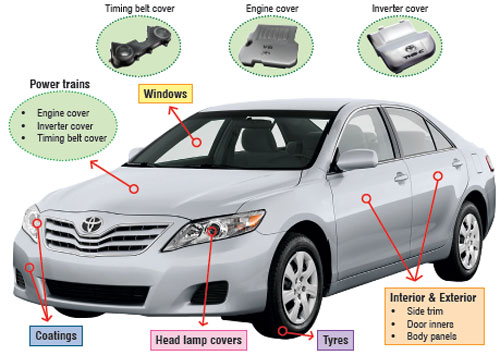
Nanocomposites are an emerging class of polymeric materials exhibiting excellent mechanical properties, enhanced modulus and dimensional stability, flame retardancy, improved scratch and mar resistance, superior thermal and processing properties, reduced warpage of components and enhanced impact resistance making them suitable to replace metals in automotive and other applications. The key drivers for the use of polymer nanocomposite-enabled parts in the automotive industry are reduction in vehicle's weight, improved engine efficiency (fuel saving), reduction in CO2 emissions and superior performance (greater safety, increased comfort and better driveability). Fig. 1 illustrates the usage of polymer nanocomposites parts.


Fig 1: Illustration of the usage of polymer nanocomposites parts.

The commercialization of polymer nanocomposites started in 1991 when Toyota Motor Co. first introduced nylon-6/clay nanocomposites in the market to produce timing belt covers as a part of the engine for their Toyota Camry cars, in collaboration with Ube industries in 1991. At about the same period, Unitika Co. of Japan introduced nylon-6 nanocomposite for engine covers on Mitsubishi GDI engines manufactured by injection moulding, the product is said to offer a 20% weight reduction and excellent surface finish. In 2002, General Motors launched a step-assist automotive component made of polyolefin reinforced with 3% nanoclays, in collaboration with Basell (now LyondellBasell Industries) for GM's Safari and Chevrolet Astro vans, followed by the application of these nanocomposites in the doors of Chevrolet Impalas.
To read more click here...

Wednesday, January 11, 2012

Stopping Power: Kinetic Energy Recovery

Engineerblogger
Jan 11, 2012


Slamming on the brakes often comes with a good amount of cursing. The car that just cut you off, the jaywalking pedestrian, the exit you missed, all deserve a few foul words. For Alberto Boretti, University of Ballarat, Australia, the cursing is directed at the brakes themselves. The energy they use to slow his vehicle, or anyone else's, is gone, never to be recovered—a source of endless frustration.

There's no good reason why it shouldn't be otherwise. "A simple mechanical device that all the kids love in their toy cars is still not applied in production vehicles because of the lack of funding," says Boretti, who spent 20 years in the automotive industry before joining the faculty at the University of Ballarat as a professor of engineering.

Kinetic Energy Recovery

In 2009, the Formula One Team Association decided to allow this device for kids' toys to be used in the speedier toys for bigger kids. The "Kinetic Energy Recovery Systems" (KERS) came in many varieties for the race cars, with the most promising storing the mechanical energy in a flywheel. The systems gave drivers a bit more acceleration, cut a theoretical fifth of a second off their lap time, and saved some energy. KERS were dropped from Formula 1 during the 2010 season (due to development costs) but are back again this year.

So far, though, the technology has not made it onto a car for the rest of us. To help prove that such a move would be a good idea, Boretti ran a simulation of a car with a flywheel KERS. In a paper he published in the International Journal of Vehicle Design, he showed that fuel consumption would be reduced by 25–33% for a typical sedan and 20% for a diesel-powered engine.


An example of a KERS device used in Formula 1 racing.

With mechanical energy being stored as mechanical energy before it's used again, 70% of the braking energy is recovered. Compare that to the regenerative braking system that a Prius currently uses: Braking is converted to electrical energy then stored as chemical energy before making the reverse journey back to help power the car. After all the losses along the way, the Prius system recovers only 30% of braking power.

Boretti's computational experiments were made with and without the continually variable transmission used with the Formula 1 flywheel system. In addition to this potential simplification, Boretti's virtual design also used a vacuum pump, where other flywheels do their rotation in a sealed vacuum. In both cases, the idea was not to increase efficiency, but to cut costs—in the hopes of luring future investors in research, as well as eventual customers. A stripped-down system like the one Boretti used would add only $400 to $500 to the price of a car. The extra cash could easily be recouped in fuel savings after just a year or so of driving.


A KERS device system.

In the current economic climate, industries and governments aren't looking to shell out the money needed to give drivers this choice. "People are looking for a device that doesn't use carbon at all—there's a lot of pressure, but no money to develop a new idea. It's quite frustrating," says Boretti. "The technology is already established. It just needs to be transformed to production."


Source: ASME

Monday, January 9, 2012

Ford Bets on the Digital Car

Engineerblogger
Jan 9, 2012


Infotainment: In an illustration of the interior of the Evos concept car from Ford, vehicle displays show games, movies, and data downloaded from the Internet. Credit: Ford

About a decade ago, Doug VanDagens, a senior executive at Ford Motor Company, raised his hand at a board meeting and asked a fundamental strategy question: Why go proprietary when the world is moving to open-source?

At the time, Ford was concerned about its Detroit rival GM. At issue was GM's OnStar, the successful in-car communication device offering emergency alerts, stolen-car tracking, and a built-in phone for an annual fee of $199 (plus cellular-minute charges). The OnStar business had two million subscribers and an 80 percent share of the car communications services market, and it was valued at over $4 billion.

GM was raking in profits, and Ford was struggling to play catch-up. It had hired 250 people and plowed over $150 million into a spin-off called Wingcast that was building a me-too answer to OnStar. But VanDagens thought the era of closed, black-box solutions was drawing to a close. The number of cell-phone subscribers was growing quickly. So was the ability of phones to communicate with other devices. "The writing was on the wall," recalls VanDagens, who today is Ford's director of connected-services solutions.

After an internal battle, VanDagens was given the job of shutting down Wingcast and laying off its staff. By the fall of 2007, Ford had instead launched Sync, a system developed with Microsoft that works with drivers' own cell phones and MP3 players. It uses Bluetooth to connect these devices to buttons on the car's stereo and steering wheel, so that drivers can make hands-free calls or have Twitter updates read aloud. No matter how fast new models of phones are introduced, they still work with Ford cars.

Sync isn't unique—Mercedes has a similar system, as do other automakers. All the same, Ford's early move to a more open technology platform has given it an edge over its crosstown rival (last year, GM announced MyLink, a Sync-like infotainment package), and it has helped turn the 108-year-old automaker into the coolest technology company in the Rust Belt.

That's important because, increasingly, digital technology sells cars. This week at the Detroit Auto Show, and simultaneously at the Consumer Electronics Show in Las Vegas, auto companies will be showing off their cars' electronic gadgetry, downloaded movies, and music, not just their engine muscle. For most consumers, navigation systems and entertainment are now a top reason to pick one car over another.
To read more click here...

Friday, January 6, 2012

Freudenberg-NOK Focuses on New Materials and Green Technologies for the Automotive Industry

Engineerblogger
Jan 6, 2012


Freudenberg-NOK Sealing Technologies, the world's largest producer of elastomeric seals and custom molded products, has helped automakers reduce emissions and improve fuel economy in three powertrain areas: gaskets, fluid power and special sealing solutions.

"With 'green' vehicles expected to garner a lot of attention at the North American International Auto Show, we are pleased that Freudenberg-NOK Sealing Technologies is a leading supplier of products that help automakers' efforts to meet market demand in this segment," said Brad Norton, senior vice president of sales and marketing, Freudenberg-NOK Sealing Technologies. "We are committed to developing innovative products for the cars on the road today and for the concepts that will be available in the future."

A common theme in many 2012 vehicles is fuel efficiency and lowered emissions. Freudenberg Sealing Technologies' new Low-Emission Sealing Solutions (LESS) helps address these automaker demands. The LESS package contains reduced-friction sealing solutions that cut wear and power loss. It contains innovative products that optimize the combustion process, support modern downsizing concepts and make start-stop systems possible.

LESS is paving the way for better performance, enhanced driving pleasure and more efficiency, while contributing to a sustainable reduction in consumption and emissions. For example, LESS solutions now in production include friction-reduced dynamic seal ranges from the Elastomeric Energy-Saving Seal or the Power-Optimized PTFE Seal.

Special Sealing Solutions

Freudenberg-NOK has developed two new piston seals that reduce friction and lower energy consumption in applications such as mechanical transmissions for the automotive industry. New products include Torque Control Seal (TCS) and D-ring with PTFE enhancement.

The TCS is a friction-optimized bonded piston that was specially developed for translational motion as a transmission shift piston. This seal combines the superior frictional characteristics of PTFE with the rigidity, centering and lip shape (similar to that of a channel gasket) of the bonded transmission piston seal with the metal carrier that was previously used. The TCS is resistant to high temperatures, allows for the mounting of a single part, has an integral piston and offers excellent centering.

The D-ring was developed as a groove seal with PTFE foil enhancement as a friction-optimized piston seal. Developed for use in a reciprocating application, the D-ring with PTFE enhancement is a general-purpose piston seal solution that offers very low coefficient of friction and high heat resistance. Offering a range of designs with different diameters, the seal does not twist, is resistant to gap extrusion and offers simple installation.

Gaskets

Freudenberg-NOK's gasket division offers a global EPDM Compound and gasket design that is ideal for use in coolant circuits using automotive coolants in engines, battery packs, power inverters or other applications using liquid thermal management. This material is currently in use at four major automotive OEMs and one commercial vehicle OEM.

The company's gasket division has also become a major partner in the electric vehicle and hybrid electric vehicle market by sealing oversized large battery housings. Thanks to its large press equipment, Freudenberg-NOK is able to produce oversized gaskets that are 1.5 meters long x 1 meter wide. They are designed with a double bead for better sealing performances together with limited reaction forces, press-in-place features for fast and easy assembly and can be designed to eliminate water intrusion on "dirty" side external modules or packs.

Fluid Power

With a variety of fluid power products for the automotive industry, Freudenberg-NOK specializes in using whatever material is needed to achieve its customers' goals. Whether the customer wants to save costs or improve fuel efficiency, Freudenberg-NOK fluid power sealing applications innovate with new materials, such as its transmission seal rings, transmission thrust washers and plastic accumulator pistons.

Freudenberg-NOK's transmission seal rings are the primary source for PTFE seal rings in North America. The company has developed substantially more durable materials and has the capability to engineer solutions for most seal, groove and bore requirements. In particular, Quantum™, PTFE, PEEK™, Torlon® and other specialty resins continue to push the boundaries of high value, engineering resins for automotive sealing applications.

With an ever-increasing focus on friction, weight, thickness and axial flatness, Torlon® transmission thrust washers with a unique, diaphragm-gating technology offer exceptional flatness capability and minimized strength loss typical with standard gating options.

Freudenberg-NOK has also expanded its sealing expertise into other related areas such as metal replacement with thermoplastic designs. The industry-recognized thermoplastic accumulator piston is chemical resistant, cost reducing, has high temperature with high load capabilities and extremely tight dimensional stability, which results in an increased system efficiency, and reduced cost.

"These solutions only scratch the surface of Freudenberg-NOK's innovations," added Norton. "We will continue to solve customer's needs in the automotive industry to meet current and future sealing requirements."

Source: The Sacramento Bee

Additional Information:

Wednesday, January 4, 2012

Fuel efficiency: The gas mileage numbers of individual vehicles have barely increased

Engineerblogger
Jan 4, 2012


Graphic: Christine Daniloff

Contrary to common perception, the major automakers have produced large increases in fuel efficiency through better technology in recent decades. There’s just one catch: All those advances have barely increased the mileage per gallon that autos actually achieve on the road.

Sound perplexing? This situation is the result of a trend newly quantified by MIT economist Christopher Knittel: Because automobiles are bigger and more powerful than they were three decades ago, major innovations in fuel efficiency have only produced minor gains in gas mileage.

Specifically, between 1980 and 2006, the average gas mileage of vehicles sold in the United States increased by slightly more than 15 percent — a relatively modest improvement. But during that time, Knittel has found, the average curb weight of those vehicles increased 26 percent, while their horsepower rose 107 percent. All factors being equal, fuel economy actually increased by 60 percent between 1980 and 2006, as Knittel shows in a new research paper, “Automobiles on Steroids,” just published in the American Economic Review (download PDF).

Thus if Americans today were driving cars of the same size and power that were typical in 1980, the country’s fleet of autos would have jumped from an average of about 23 miles per gallon (mpg) to roughly 37 mpg, well above the current average of around 27 mpg. Instead, Knittel says, “Most of that technological progress has gone into [compensating for] weight and horsepower.”

And considering that the transportation sector produces more than 30 percent of U.S. greenhouse gas emissions, turning that innovation into increased overall mileage would produce notable environmental benefits. For his part, Knittel thinks it is understandable that consumers would opt for large, powerful vehicles, and that the most logical way to reduce emissions is through an increased gas tax that leads consumers to value fuel efficiency more highly.

“When it comes to climate change, leaving the market alone isn’t going to lead to the efficient outcome,” Knittel says. “The right starting point is a gas tax.”

Giving the people what they want

While auto-industry critics have long called for new types of vehicles, such as gas-electric hybrids, Knittel’s research underscores the many ways that conventional internal-combustion engines have improved.

Among other innovations, as Knittel notes, efficient fuel-injection systems have replaced carburetors; most vehicles now have multiple camshafts (which control the valves in an engine), rather than just one, allowing for a smoother flow of fuel, air and exhaust in and out of engines; and variable-speed transmissions have let engines better regulate their revolutions per minute, saving fuel.

To be sure, the recent introduction of hybrids is also helping fleet-wide fuel efficiency. Of the thousands of autos Knittel scrutinized, the most fuel-efficient was the 2000 Honda Insight, the first hybrid model to enter mass production, at more than 70 mpg. (The least fuel-efficient car sold in the United States that Knittel found was the 1990 Lamborghini Countach, a high-end sports car that averaged fewer than nine mpg).

To conduct his study, Knittel drew upon data from the National Highway Transportation Safety Administration, auto manufacturers and trade journals. As those numbers showed, a major reason fleet-wide mileage has only slowly increased is that so many Americans have chosen to buy bigger, less fuel-efficient vehicles. In 1980, light trucks represented about 20 percent of passenger vehicles sold in the United States. By 2004, light trucks — including SUVs — accounted for 51 percent of passenger-vehicle sales.

“I find little fault with the auto manufacturers, because there has been no incentive to put technologies into overall fuel economy,” Knittel says. “Firms are going to give consumers what they want, and if gas prices are low, consumers are going to want big, fast cars.” And between 1980 and 2004, gas prices dropped by 30 percent when adjusted for inflation.

The road ahead

Knittel’s research has impressed other scholars in the field of environmental economics. “I think this is a very convincing and important paper,” says Severin Borenstein, a professor at the Haas School of Business at the University of California at Berkeley. “The fact that cars have muscled up rather than become more efficient in the last three decades is known, but Chris has done the most credible job of measuring that tradeoff.” Adds Borenstein: “This paper should get a lot of attention when policymakers are thinking about what is achievable in improved automobile fuel economy.”

Indeed, Knittel asserts, given consumer preferences in autos, larger changes in fleet-wide gas mileage will occur only when policies change, too. “It’s the policymakers’ responsibility to create a structure that leads to these technologies being put toward fuel economy,” he says.

Among environmental policy analysts, the notion of a surcharge on fuel is widely supported. “I think 98 percent of economists would say that we need higher gas taxes,” Knittel says.

Instead, the major policy advance in this area occurring under the current administration has been a mandated rise in CAFE standards, the Corporate Average Fuel Economy of cars and trucks. In July, President Barack Obama announced new standards calling for a fleet-wide average of 35.5 mpg by 2016, and 54.5 mpg by 2025.

According to Knittel’s calculations, the automakers could meet the new CAFE standards by simply maintaining the rate of technological innovation experienced since 1980 while reducing the weight and horsepower of the average vehicle sold by 25 percent. Alternately, Knittel notes, a shift back to the average weight and power seen in 1980, along with a continuation of the trend toward greater fuel efficiency, would lead to a fleet-wide average of 52 mpg by 2020.

That said, Knittel is skeptical that CAFE standards by themselves will have the impact a new gas tax would. Such mileage regulations, he says, “end up reducing the cost of driving. If you force people to buy more fuel-efficient cars through CAFE standards, you actually get what’s called ‘rebound,’ and they drive more than they would have.” A gas tax, he believes, would create demand for more fuel-efficient cars without as much rebound, the phenomenon through which greater efficiency leads to potentially greater consumption.

Fuel efficiency, Knittel says, has come a long way in recent decades. But when it comes to getting those advances to have an impact out on the road, there is still a long way to go.

Source:  MIT News

Monday, December 19, 2011

Can motors in wheels spark electric car revolution?

Engineerblogger
Dec 19, 2011


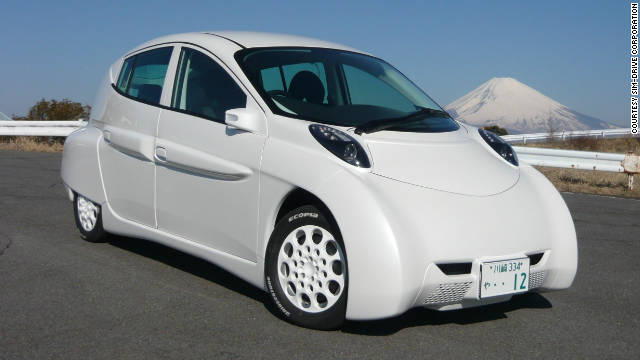
The SIM-LEI electric car can travel 333 kilometers on a single charge, say its creators.

There may have been more alluring electric cars on display at this year's Tokyo Motor Show, but the beauty of this prototype lies in its performance.

The SIM-LEI can travel 333 kilometers (more than 200 miles) on a single charge, say its Japanese creators SIM Drive, and it also boasts supercar-like acceleration -- 0 to 60 mph in just 4.8 seconds.

The key to these remarkable statistics lies not, as you might expect, underneath the hood but in its wheels.

Most electric vehicles house a single motor in the area vacated by the petrol engine, but the SIM-LEI has four motors, which fit in the hubs its wheels.

Each one delivers 65 kilowatts, giving the car a total output of 260 kilowatts, compared with the 80 kilowatts of output available in, say, the Nissan Leaf.

A 24.5 kWh battery sits below the floor along with inverters and controllers, which fit into a unique steel monocoque helping reduce weight, according to SIM Drive.

The SIM-LEI -- LEI stands for Leading Efficiency In-Wheel motor -- took 15 months to complete and builds on advances made with the fantastic-looking Eliica -- a super-fast eight-wheeler designed by SIM Drive CEO and President Hiroshi Shimizu.

His latest design may not look so sporty but the SIM LEI does come with low-friction tires and a low-set chassis, which helps reduce drag, says the company.

Recent technological advances are making in-wheel motors more attractive, says James Widmer, from the Center for Advanced Electrical Drives at the UK's Newcastle University.

"Motors have become more powerful for their weight and the volume they take up, which has made it more practical to get very good performance from putting electric motors directly in the wheels of cars," Widmer said.

And electric motors provide drivers with far greater control than internal combustion engines, he says.

"If you do put an electric motor in each wheel then there are huge possibilities with things like traction control and stability control," he added.

While car makers including Peugeot and Mitsubishi have used in-wheel motors in concept cars that have never been commercially available, SIM Drive hopes its four-seat sedan will go into production in 2013.

SIM Drive says the price will depend on how many it makes, but if the car ends up being mass produced, customers can expect to pay around ¥2.5 million ($32,000).

Source: CNN

Tuesday, December 13, 2011

GM and BMW to cooperate on fuel cells

Engineerblogger
Dec 13, 2011


According to Reuters, BMW and General Motors plan to join forces on the development of fuel cell technology, German weekly business magazine Wirtschaftswoche reported, citing industry sources.

Talks between the two companies are highly advanced, the magazine said on Saturday, adding that the carmakers were close to signing a cooperation agreement.

The plan would give BMW future access to GM's fuel cell technology and in exchange, BMW would contribute to the research costs, the magazine said in an article released in advance of publication on Monday.

The magazine said GM declined to comment.

"We are speaking to GM about various future technologies but we are not saying anything more beyond that," a BMW spokesman said.

Monday, December 12, 2011

Advanced Carbon Fiber Nears Broad Automotive Use

Engineerblogger
Dec 12, 2011


Teijin Limited, a leader in the carbon fiber and composites industry, and General Motors, announce an agreement to co-develop technology to reduce vehicle weight and improve fuel economy Thursday, December 8, 2011 in Detroit, Michigan. Teijin Senior Managing Director Norio Kamei (left) and GM Vice Chairman Steve Girsky shake hands after signing the documents. (Photo by Jeffrey Sauger for General Motors)

  • GM and Teijin will co-develop technology to reduce vehicle weight, improve fuel economy
  • Teijin to open U.S. technical center to facilitate collaborative development

General Motors and Teijin Limited., a leader in the carbon fiber and composites industry, will co-develop advanced carbon fiber composite technologies for potential high-volume use globally in GM cars, trucks and crossovers.

The co-development pact signed today involves use of Teijin’s innovative carbon fiber reinforced thermoplastic (CFRTP) technology, a faster and more efficient way to produce carbon fiber composites that potentially could be introduced on mainstream vehicles. For Teijin, the arrangement could lead to widening its portfolio beyond specialty and high-end automotive carbon fiber applications.

“Our relationship with Teijin provides the opportunity to revolutionize the way carbon fiber is used in the automotive industry,” said GM Vice Chairman Steve Girsky. “This technology holds the potential to be an industry game changer and demonstrates GM’s long-standing commitment to innovation.”

To support the relationship, Teijin will establish the Teijin Composites Application Center, a technical center in the northern part of the United States early next year.

As carbon fiber is 10 times stronger than regular-grade steel yet only one-quarter of the weight, carbon fiber composites used as automobile components are expected to dramatically reduce vehicle weight. Consumers benefit from lighter weight vehicles with better fuel economy and all the safety benefits that come with vehicles of greater mass.

Teijin's proprietary breakthrough is its ability to mass-produce carbon fiber-reinforced thermoplastic components with cycle times of under a minute. Conventional carbon fiber-reinforced composites use thermosetting resins and require a much longer timeframe for molding. This time factor has limited the use of carbon fiber in high-volume vehicles.

Teijin recently received a 2011 Global Automotive Carbon Composites Technology Innovation Award by Frost & Sullivan. The technology also was selected by ICIS Innovation Awards 2011 as the overall winner and the recipient of the Best Product Innovation award.

Increasingly, strict global environmental standards and fuel economy regulations have intensified the need to reduce vehicle mass by using lightweight materials in place of high-tension steel or aluminum.

The Teijin Group, which has identified automobiles as a key growth market, accelerated the new technology development through collaboration by the Teijin Composites Innovation Center and Toho Tenax Co. Ltd., where the mass-production technology for carbon fiber reinforced plastic components using thermoplastic resin was successfully developed.

“Teijin’s innovative CFRTP technology, which promises to realize revolutionarily lighter automotive body structures, will play an important role in GM’s initiative to bring carbon fiber components into mainstream vehicles,” said Norio Kamei, senior managing director of Teijin. “We believe our visionary relationship with GM will lead the way in increased usage of green composites in the automotive industry.”

The launch of any carbon fiber-intensive vehicle applications resulting from the relationship would be announced closer to market readiness. The agreement does not involve an exchange of equity between the companies.

Source: General Motors

Thursday, December 8, 2011

Researchers Releases Report on Testing Electric Vehicles to Optimize their Performance with Power Grids

Engineerblogger
Dec 8, 2011


Researchers at the U.S. Department of Energy’s National Renewable Energy Laboratory (NREL) have released a technical report that could help improve the performance of electric vehicles (EVs) and the efficiency of the electric utility grids that power them.

The report documents a series of test procedures designed to enable engineers, designers and utilities to evaluate the performance of various EVs and hybrids to optimize how they connect with electric utility grids today – and “smart grids” in the future. As more vehicles with large batteries come into use and smart grid technology advances, grid operators in the future may be able to take advantage of the two-way flow of power from EVs and hybrids plugged into utility grids to smooth spikes in demand and improve the reliability of their systems. Evaluating today’s vehicle technologies will advance the goal of transforming the nation’s transportation system to maximize efficiency and use of clean energy.

Engineering vehicles capable of interconnecting to the power system for bi-directional power flow is a key component of emerging “vehicle-to-grid” systems, in which plug-in EVs communicate with the power grid to deliver electricity or modulate their charging rates. The global vehicle-to-grid (V2G) market is expected to grow at a rapid pace, reaching the $2.25 billion mark in 2012 and accelerating to $40.4 billion by 2020, according to a new market analysis from GlobalData.

“This report offers the first nationally available set of test procedures for V2G applications,” NREL Director of Energy Systems Integration Ben Kroposki said. “Unleashing the potential of electric vehicles to optimize grid performance will be instrumental as the world moves to a smart grid with much higher use of renewables, energy storage and load control.

The NREL report, Interim Test Procedures for Evaluating Electrical Performance and Grid Integration of Vehicle-to-Grid Applications, documents a series of tests developed to evaluate various V2G capable electric and hybrid electric vehicles to determine their ability to store and provide power to the utility grid and to connect and disconnect from the utility grid, while complying with IEEE standards. The report includes a general discussion on safety requirements and general test setup, as well as an overview of vehicle characteristics and test equipment. Each test scenario discusses the purpose of the test, test procedure, corresponding standards, and how the results are reported.

“NREL has developed these procedures based on our experience testing V2G-capable electric and hybrid vehicles,” said Sudipta Chakraborty, NREL research engineer and lead author of the report. “As we test additional vehicles, we expect that the test procedure will evolve to become more universal.”

The intent of this report is to provide a way to evaluate V2G applications for utility interconnection – helping pave the way for wider use of EV’s and hybrids, as well as clean renewable energy for transportation – in the future. The test procedures also might become the industry standard down the road.

“We developed the test procedures in this report using actual prototype vehicles equipped with advanced power electronics and advanced energy storage technologies,” said Bill Kramer, acting group manager for NREL’s Distributed Energy Systems Integration Group. “Once testing is expanded to a wider variety of vehicles, these procedures could become the foundation for testing standards for V2G applications.”

Source:  National Renewable Energy Laboratory(NREL)

Additional Information:

Wednesday, December 7, 2011

Daimler Tests Cordless Electric Vehicle Chargers

Engineerblogger
Dec 07, 2011

Daimler has modified a E-Cell plug-in hybrid concept vehicle like this one to allow it to charge without having to plug in. So what will we call plug-in hybrids now?  Credit: Daimler


Having a few electric vehicle charging stations here and there isn't a big deal. But if they ever become common in cities, they'll be an eyesore, with their long, tangled black cords clumped onto their sides or sprawling across parking spaces to the outlet on the side of a car. Charging stations could also be a tempting target for vandals.

A much more elegant solution would be to bury inductive chargers under parking spots, a concept that Daimler has started testing. The chargers could be invisible and protected from vandals. And they could make charging easier—just pull into a parking spot, and the car can start charging.

Daimler, along with Conductix-Wampfler, a company based in Germany, has only recently started testing cars equipped with the inductive charging coils. But the initial results look positive.

The system is 90 percent efficient, which isn't as good as charging with a cable, but is better than some other inductive charging systems. The companies say that when you count efficiency losses within the car, the system is almost as good as plugging in.

In initial tests, after two or three practice runs, drivers have been able to successfully park their cars so that they're centered over the charging coils.

An object detection system is supposed to avoid the potential problem of the buried coils heating up a piece of metal left on the road. The prototypes are based on a wireless charging system developed for electric buses that has been operating since 2003.

It will be interesting to see how the cost of the system compares to conventional chargers, and whether it will still be necessary to install a post for communications gear, to allow drivers to pay for the charge with their credit cards, for example. Ultimately, cities will have to decide whether the better looks and convenience are worth the sacrifice in energy efficiency.

The company WiTricity is developing chargers that could be more convenient still, charging efficiently at distances greater than is allowed by inductive charging.

Source:  Technology Review

New engine could be an alternative to batteries

Engineerblogger
Dec 7, 2011


Cryogenic engines operate through controlled vaporisation of cryogenic liquids (eg: liquid nitrogen, air) through application of heat (which can come from the environment or waste heat sources). If this vaporisation takes place within a confined space then significant pressures can be generated. This pressure can be converted into work through use of any type of expansion engine. This concept has been used to power cryogenic pumps and companies like Highview Power Storage are commercialising the process at large scale for energy storage.

Whereas most cryogenic engines use heat exchangers for indirect heat transfer, the Dearman Engine is a radical refinement of this process whereby a heat transfer fluid (water or ethylene glycol) is used to transfer heat to the cryogenic liquid inside the expansion engine through direct contact heat exchange between the cryogenic liquid and the heat transfer fluid.

Liquefied Air versus Compressed Air
Liquefied air is easier to store and manage than compressed air which is already used for energy storage, and indeed powering cars. There is no need to store it at high pressure in an expensive and bulky pressure vessel: just keep it cold in a standard, insulated, low pressure tank. Liquid air/liquid nitrogen also have significantly better energy density than compressed air (four to six times) so requires far less space. In fact one litre of liquid air when regasified becomes 710 litres of air.

Dearman technology versus other cryogen power generation technologies
The Dearman Engine combines the benefits of other cryogenic power generation technologies (low cost, high energy density, zero emission and free cooling) with its key inventive step; the heating of the cryogenic liquid (the “fuel”) through direct contact with a heat exchange fluid inside the engine. This reduces the requirement and cost for (i) multi-stage expanders or (ii) large and expensive high pressure heat exchangers to turn the “fuel” to gas before it gets into the engine, the heat exchange fluid is also the medium by which we can easily add heat or deliver cold.

Additionally direct contact heat exchange can cause very rapid boiling leading to vary high rates of pressurisation; while, because the thermal source is applied and present during the expansion phase, there is the prospect of a quasi-isothermal expansion and increased work output.

Finally, along with a being a cheaper solution, as a reciprocator engine the Dearman Engine can scale down to a few kWs as well as still potentially scaling up for 10s of MW applications.

Dearman technology versus batteries and other zero emission powertrains / batteries
An assessment of a cryogenic powertrain concept using the Dearman technology and its suitability for use in a variety of automotive applications as a Zero Emission Vehicle (ZEV) has been carried out by our academic partners and industry powertrain specialists. The key conclusions were:
  • The technology may be competitive for certain classes of vehicle should regulations or incentives favour the use of ZEVs. These include taxis, urban cycle buses and light commercial vehicles for urban cycles (such as delivery vans).
  • Whilst performance and range are compromised compared with internal combustion engines (as are all alternative vehicle solutions such as batteries), cryogenic powertrain technology offers the prospect of two key advantages compared with current economically viable battery electric vehicles. First there is improved energy density and therefore range. Secondly there is rapid re-fuelling capability (3-4 minutes) enabling improved vehicle utilization.
  • The peak operating temperature of the engine is approximately ambient so high temperature tolerance is not required; this yields potential weight and cost savings.
  • Technologies are mature for handling and transporting cryogenic liquids.
  • The concept of Combined Cold and Power could offer significant commercial transport advantages – e.g. chilled delivery vehicles, where the energy and capital costs and the weight of the refrigeration unit are already captured in the powertrain.
  • The engine could harness waste energy from braking.
The key engineering challenge was optimizing the injection of liquid nitrogen into the cylinder but that all the technologies involved, including the LN2 storage tanks, were mature enough not to be showstoppers.

Tuesday, December 6, 2011

Foldable robot scooter wows at Tokyo Motor Show

Engineerblogger
Dec 06, 2011


Japan's robot venture Kowa-tmsuk unveils its electric personal mobility "Kobot" at a press preview of the Tokyo Motor Show on December 1, 2011. The ultra compact electric vehicle features extensible and collapsible mechanisms for a reduced parking space footprint


A foldable robot scooter controlled by a smart phone wowed visitors to the Tokyo Motor Show on Thursday as its makers unveiled what they hope will be the future of urban driving.

The Kobot is a three-wheel scooter with just one seat that can can be packed away after use in a space of around one square metre (10 square feet).

With a target speed of 30 kilometres (18 miles) per hour, makers Kowa Tmsuk hope the electrically-powered vehicle will be perfect for navigating crowded city streets, without adding to air pollution.

"This is a robot you can ride," said Yoichi Takamoto, the president of Tmsuk, one half of the joint venture and a company that has previously developed robots designed for medical care and disaster rescue operations.

The driver uses a smart phone to remotely tell the Kobot to fold its rear wheel and seat onto the main body of the vehicle when not in use, something designers say is ideal for cities like Tokyo where parking space is at a premium.

Kowa Tmsuk president Yoshito Serita said his company was aiming to have the vehicles ready for the market by next autumn.

"They are unique vehicles designed to be super-small, super-zippy and full of playful spirit," he said.

Other non-auto companies were also displaying their wares at the motor show, which opened Wednesday.

Japanese synthetic fibre maker Toray Industries, which supplies carbon fibre materials for Boeing's fuel-efficient 787 Dreamliner aircraft, was showing off its concept electric vehicle made of the same materials as the plane.

The car, named "Teewave", has a body made entirely of the light-weight carbon fibre, which its designers say will make it not only cheaper to run, but stronger too.

Source: AFP

Monday, December 5, 2011

Toyota, BMW To Collaborate On Greener Car Battery

Engineerblogger
Dec 5, 2011


Auto giants Toyota and BMW said Thursday they have agreed to collaborate on research for cleaner, next-generation car batteries, underlining the growing push in the industry for green technology.

The agreement brings together Toyota Motor Corp., Japan's No. 1 carmaker and a leader in gas-electric hybrids, and BMW AG of Germany, a European maker that has a strong luxury brand image in both Japan and Europe.

"We are now joining forces to further develop environmentally-friendly technologies and to expand our innovation leadership in each of our segments," Norbert Reithofer, chairman of BMW, said in a statement.

The two automakers will also work on improving lithium-ion battery technology, typically used in batteries for electronic gadgets and relatively new to autos.

Toyota has struggled to find a good lithium-ion battery for its green cars and is using technology from Japanese electronics maker Sanyo Electric Co. in its latest plug-in hybrid, for which Toyota has recently started taking orders. Toyota had worked with Panasonic Corp. on a battery before the electronics maker acquired Sanyo, partly to get better lithium-ion technology.

"This collaboration will allow for the development of the next-generation battery faster and at a higher level," Toyota Executive Vice President Takeshi Uchiyamada told reporters at a Tokyo news conference.

Toyota and BMW have been engaged in extended discussions on technology and plan to collaborate on other medium-term and long-term projects, he said.

BMW will also begin supplying "clean" diesel engines to Toyota in 2014 for models for the European market. Diesel engines for passenger cars are huge in Europe but have yet to take off in the U.S. or Japan, the two major markets where Toyota is strong. Toyota does not have enough clean diesel engines for its European offerings.

Under their agreement, BMW is supplying 1.6 liter and 2.0 liter fuel-efficient diesel engines for Toyota. They declined to give details on models.

The announcement was timed with the Tokyo Motor Show, which opens to the public Saturday.

Competition in new batteries is expected to heat up in coming years amid growing concern about global warming. Governments around the world are offering tax breaks and subsidies to encourage electric cars and plug-ins.

BMW said it is entering its first collaboration with a Japanese automaker because of Toyota's prowess in hybrids.

Toyota has sold more than 3.4 million hybrids worldwide so far, including models other than the pioneering hit Prius.

Toyota does not have an electric vehicle in its commercial lineup, although it is planning one for next year, for commuting short distances.

Japanese rival Nissan Motor Co. has made EVs the pillar of its green strategy and has a head start, offering the Leaf electric car from last year.

But electric vehicles are still a fledgling technology, meaning the race has just begun and others like Toyota and BMW can play catchup.

Nissan has sold about 20,000 Leaf cars around the world so far.

Toyota and BMW executives said sharing research can speed up development.

"The agreement between our two companies marks a milestone for our future collaborations," said Ian Robertson, a BMW board member who oversees sales and marketing.