Pages

Subscribe:

Ads 468x60px

Showing posts with label Biofuel. Show all posts

Tuesday, January 17, 2012

Want Cheap Biofuel? A Startup Makes It with Natural Gas

Technology Review
Jan 17, 2012


Fast fuel: Virent’s 100-liter-per-day pilot plant, shown here, produces fuel for Formula 1 race cars. Credit: Virent


Virent, a biofuels company based in Madison, Wisconsin, has developed a potentially inexpensive way to make gasoline and other valuable chemicals out of grass and wood chips. Its approach reduces costs by simplifying or eliminating expensive processing steps, and by using natural gas to increase the amount of fuel that can be made from a given amount of biomass.

In some ways, the process is similar to the one used to refine oil. Virent has demonstrated that it can use it to make gasoline, diesel, and jet fuel, and its 100-liter-per-day gasoline pilot plant makes fuel that's used in Formula 1 racing.

As with many other biofuels companies, Virent's first large-scale product may not be fuel at all. It recently announced a development agreement with Coca-Cola to produce a chemical that can be used to make plastic soda bottles, and is hoping to build a plant for this purpose in 2015.

The company's technology addresses one of the big challenges with making advanced biofuels. This is that making hydrocarbon fuels from grass requires breaking down the long cellulose molecules that make up the bulk of the raw material. Breaking the biomass down is expensive, and is normally done with enzymes that produce sugar, or using high temperatures and pressures to turn it into carbon monoxide and hydrogen gas. Virent's process produces intermediate-sized molecules known as oligomers that require less processing. Its core technology is a way to transform those oligomers into fuel.

Making hydrocarbons from biomass requires first removing the oxygen. Virent has also developed inorganic catalysts that remove most of the oxygen from the molecules it produces. It then uses a series of chemical reactions to remove the remaining oxygen and reconfigure the molecules to take on the properties needed to make in fuels like gasoline or chemicals for making plastic bottles.
To read more click here...

Friday, January 13, 2012

Algae for your fuel tank: New process for producing biodiesel from microalgae oil

Engineerblogger
Jan 13, 2012

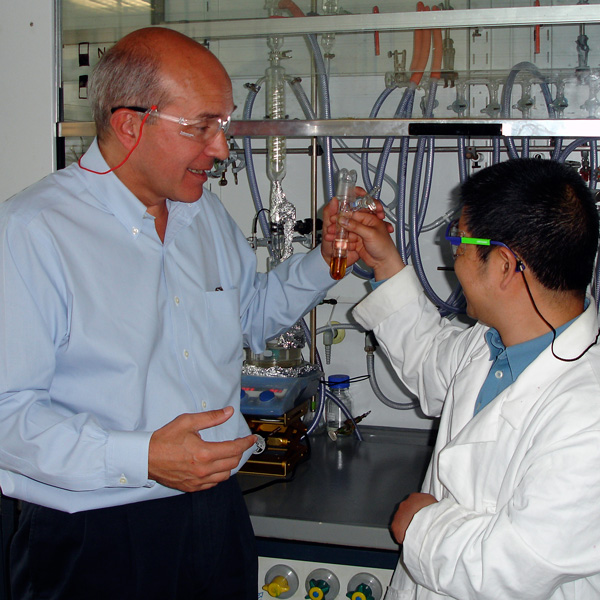
Prof. Lercher with a scientist of his team - Photo: Battenberg/TUM

 The available amount of fossil fuels is limited and their combustion in vehicle motors increases atmospheric CO2 levels. The generation of fuels from biomass as an alternative is on the rise. In the journal Angewandte Chemie, Johannes A. Lercher and his team at the Technische Universitaet Muenchen have now introduced a new catalytic process that allows the effective conversion of biopetroleum from microalgae into diesel fuels.

Plant oils from sources such as soybean and rapeseed are promising starting materials for the production of biofuels. Microalgae are an interesting alternative to these conventional oil-containing crops. Microalgae are individual cells or short chains of cells from algae freely moving through water. They occur in nearly any pool of water and can readily be cultivated. “They have a number of advantages over oil-containing agricultural products,” explains Lercher. “They grow significantly faster than land-based biomass, have a high triglyceride content, and, unlike the terrestrial cultivation of oilseed plants, their use for fuel production does not compete with food production.”

Previously known methods for refining oil from microalgae suffer from various disadvantages. The resulting fuel either has too high an oxygen content and poor flow at low temperatures, or a sulfur-containing catalyst may contaminate the product. However, other catalysts are still not efficient enough. The Munich scientists now propose a new process, for which they have developed a novel catalyst: nickel on a porous support made of zeolite HBeta. They have used this to achieve the conversion of raw, untreated algae oil under mild conditions (260 °C, 40 bar hydrogen pressure). Says Lercher: “The products are diesel-range saturated hydrocarbons that are suitable for use as high-grade fuels for vehicles.”

The oil produced by the microalgae is mainly composed of neutral lipids, such as mono-, di-, and triglycerides with unsaturated C18 fatty acids as the primary component (88 %). After an eight-hour reaction, the researchers obtain 78 % liquid alkanes with octadecane (C18) as the primary component. The main gas-phase side products are propane and methane.

Analysis of the reaction mechanism shows that this is a cascade reaction. First the double bonds of the unsaturated fatty acid chains of the triglycerides are saturated by hydrogen. Then, the now saturated fatty acids take up hydrogen and are split from their glycerin component, which reacts to form propane. In the final step, the acid groups in the fatty acids are reduced stepwise to the corresponding alkane.

Source:   Technische Universitaet Muenchen 

Additional Information:
  • Towards Quantitative Conversion of Microalgae Oil to Diesel-Range Alkanes with Bifunctional Catalysts, B. Peng, Y. Yao, C. Zhao und J.A. Lercher,  Angewandte Chemie, 2011 – Doi: 10.1002/ange.201106243

Wednesday, January 11, 2012

Renewable Energy: Clearing a Potential Road Block to Bisabolane

Engineerblogger
Jan 11, 2012


JBEI researchers determined the structure of the AgBIS enzyme and found it to consist of three helical domains, the first three-domain structure ever found in a synthase of sesquiterpenes. This discovery holds importance for advanced biofuels and other applications. Credit: Lawrence Berkeley National Laboratory


The recent discovery that bisabolane, a member of the terpene class of chemical compounds used in fragrances and flavorings, holds high promise as a biosynthetic alternative to D2 diesel fuel has generated keen interest in the green energy community and the trucking industry. Now a second team of researchers with the U.S Department of Energy (DOE)’s Joint BioEnergy Institute (JBEI) has determined the three-dimensional crystal structure of a protein that is key to boosting the microbial-based production of bisabolane as an advanced biofuel.

The JBEI research team, led by bioengineers Paul Adams and Jay Keasling, solved the protein crystal structure of an enzyme in the Grand fir (Abies grandis) that synthesizes bisabolene, the immediate terpene precursor to bisabolane. The performance of this enzyme – the Abies grandis α-bisabolene synthase (AgBIS) – when engineered into microbes, has resulted in a bottleneck that hampers the conversion by the microbes of simple sugars into bisabolene.

“Our high resolution structure of AgBIS should make it possible to design changes in the enzyme that will enable microbes to make bisabolene faster,” says Adams, a leading authority on x-ray crystallography. “It should also enable us to engineer out inhibition effects that slow throughput, and perhaps also engineer the enzyme to produce other kinds of fuels similar to bisabolane.”

Adams, who heads JBEI’s Technologies Division, is the corresponding author of a paper describing this work in the Cell Press journal Structure. The paper is titled “Structure of a Three-Domain Sesquiterpene Synthase: A Prospective Target for Advanced Biofuels Production.” Co-authoring it with Adams and Keasling were Ryan McAndrew, Pamela Peralta-Yahya, Andy DeGiovanni, Jose Pereira and Masood Hadi.

JBEI is one of three DOE Bioenergy Research Centers established by DOE’s Office of Science to advance the technology for the commercial production of advanced biofuels. It is a multi-institutional partnership led by the Lawrence Berkeley National Laboratory (Berkeley Lab) and headquartered in Emeryville, CA.

This past fall, JBEI researchers identified bisabolane as a potential new advanced biofuel that could replace D2 diesel, today’s standard fuel for diesel engines, with a clean, green, renewable alternative that’s produced in the United States. Using the tools of synthetic biology, the researchers engineered strains of bacteria and yeast to produce bisabolene from simple sugars, which was then hydrogenated into bisabolane. While showing much promise, the yields of bisabolene have to be improved for microbial-based production of bisabolane fuel to be commercially viable.

“The inefficient terpene synthase enzyme is one of the bottlenecks in the metabolic pathway used by the engineered microbes,” says Peralta-Yahya, a lead member of the earlier JBEI team as well as the current team. “Knowing the AgBIS crystal structure will guide us in engineering it for improved catalytic efficiency and stability, which should bring our bisabolene yields closer to economic competitiveness.”

Peralta-Yahya and her colleagues determined that the AgBIS enzyme consists of three helical domains, the first three-domain structure ever found in a synthase of sesquiterpenes – terpene compounds that contain 15 carbon atoms. The discovery of this unique structure holds importance on several fronts, as co-lead author of the Structure paper McAndrew explains.

“That we found the structure of AgBIS to be more similar to diterpene (20 carbon terpene compounds) synthases not only provides us with insight into the function of these less well characterized enzymes, it also provides us with clues to the evolutionary heritage as the archetypal three-domain terpenoid synthases became two-domain sesquiterpene synthases in plants. Furthering our knowledge of the structures and functions of terpenoid synthases may prove to have abundant practical applications aside from advanced biofuels because these enzymes produce a wide variety of specialized chemicals.”

Solving the three-dimensional crystal structure of AgBIS was made possible by the protein crystallography capabilities of Berkeley Lab’s Advanced Light Source (ALS), a DOE Office of Science national user facility for synchrotron radiation, and the first of the world’s third generation light sources. For this work, the JBEI team used three of the five protein crystallography beamlines operated by the Berkeley Center for Structural Biology (BCSB) – beamlines 8.2.1, 8.2.2, and 5.0.3.

“We needed to use multiple beamlines because we collected data on several crystals – the protein by itself, and the protein with different inhibitors/cofactors,” says Adams, who headed the BCSB from 2004 to 2011. “Also, the approach we used to solve the AgBIS structure required high flux tunable x-rays such as those provided at 8.2.1 and 8.2.2, which are superbend beamlines.”

This research was supported by the DOE Office of Science.

Source: Lawrence Berkeley National Laboratory

Monday, January 9, 2012

Powering insect cyborgs with an implantable biofuel cell

Engineerblogger
Jan 9, 2012


Researchers have developed a biofuel cell to enable the development of 'insect cyborgs' Image: Shutterstock

Research into developing insect cyborgs for use as first responders or super stealthy spies has been going on for a while now. Most research has focused on using batteries, tiny solar cells or piezoelectric generators to harvest kinetic energy from the movement of an insect's wings to power the electronics attached to the insects. Now a group of researchers at Case Western Reserve University have created a power supply that relies just on the insect's normal feeding.

Recognizing that using a real insect is much easier than starting from scratch to create a device that works like an insect, Case Western Reserve chemistry professor teamed up with graduate student Michelle Rasmussen, biology professor Roy E. Ritzmann, chemistry professor Irene Lee and biology research assistant Alan J. Pollack to develop an implantable biofuel cell to provide usable power for the various sensors, recording devices, or electronics used to control an insect cyborg.

To convert chemical energy harvested from the insect and turn it into electricity, the team used two enzymes in series to create the anode. The first enzyme breaks down the sugar trehalose, which a cockroach constantly produces from its food, into two simpler sugars, called monosaccarides, while the second enzyme oxidizes the monosaccarides to release electrons. A current them flows as the electrons are drawn to the cathode, where oxygen from air takes up the electrons and is reduced to water.

After testing the system using trehalose solution, the team inserted prototype electrodes in a blood sinus away from critical organs in the abdomen of a female cockroach. The cockroaches suffered no long-term damage, which the researchers say bodes well for long-term use.

"Insects have an open circulatory system so the blood is not under much pressure," Ritzmann explained. "So, unlike say a vertebrate, where if you pushed a probe into a vein or worse an artery (which is very high pressure) blood does not come out at any pressure. So, basically, this is really pretty benign. In fact, it is not unusual for the insect to right itself and walk or run away afterward."

Using an instrument called a potentiostat, the team determined the maximum power density of the fuel cell reached nearly 100 microwatts per square centimeter at 0.2 volts, with a maximum current density of about 450 microamps per square centimeter.

The researchers are now working to miniaturize the fuel cell so that it can be fully implanted into an insect while still allowing it to run or fly normally and examining which materials might last for a long time inside an insect. They are also working with other researchers to develop a signal transmitter that can run on little energy and also exploring how to add a lightweight rechargeable battery to the system.

"It's possible the system could be used intermittently," Scherson said. "An insect equipped with a sensor could measure the amount of noxious gas in a room, broadcast the finding, shut down and recharge for an hour, then take a new measurement and broadcast again."

The Case Western Reserve University team's work was published last week in the Journal of the American Chemical Society.


Source: Gizmag

Monday, November 21, 2011

Biofuels from Switchgrass: Researchers Boost Switchgrass Biofuels Potential by Adding a Maize Gene to Switchgrass

Engineerblogger
Nov 21, 2011

Introducing a maize gene into switchgrass substantially boosted the potential of the switchgrass biomass as an advanced biofuel feedstock. (Photo courtesy of USDA/ARS)


Many experts believe that advanced biofuels made from cellulosic biomass are the most promising alternative to petroleum-based liquid fuels for a renewable, clean, green, domestic source of transportation energy. Nature, however, does not make it easy. Unlike the starch sugars in grains, the complex polysaccharides in the cellulose of plant cell walls are locked within a tough woody material called lignin. For advanced biofuels to be economically competitive, scientists must find inexpensive ways to release these polysaccharides from their bindings and reduce them to fermentable sugars that can be synthesized into fuels.

An important step towards achieving this goal has been taken by researchers with the U.S. Department of Energy (DOE)’s Joint BioEnergy Institute (JBEI), a DOE Bioenergy Research Center led by the Lawrence Berkeley National Laboratory (Berkeley Lab).

A team of JBEI researchers, working with researchers at the U.S. Department of Agriculture’s Agricultural Research Service (ARS), has demonstrated that introducing a maize (corn) gene into switchgrass, a highly touted potential feedstock for advanced biofuels, more than doubles (250 percent) the amount of starch in the plant’s cell walls and makes it much easier to extract polysaccharides and convert them into fermentable sugars. The gene, a variant of the maize gene known as Corngrass1 (Cg1), holds the switchgrass in the juvenile phase of development, preventing it from advancing to the adult phase.

“We show that Cg1 switchgrass biomass is easier for enzymes to break down and also releases more glucose during saccharification,” says Blake Simmons, a chemical engineer who heads JBEI’s Deconstruction Division and was one of the principal investigators for this research. “Cg1 switchgrass contains decreased amounts of lignin and increased levels of glucose and other sugars compared with wild switchgrass, which enhances the plant’s potential as a feedstock for advanced biofuels.”

The results of this research are described in a paper published in the Proceedings of the National Academy of Sciences (PNAS) titled “Overexpression of the maize Corngrass1 microRNA prevents flowering, improves digestibility, and increases starch content of switchgrass.”

Lignocellulosic biomass is the most abundant organic material on earth. Studies have consistently shown that biofuels derived from lignocellulosic biomass could be produced in the United States in a sustainable fashion and could replace today’s gasoline, diesel and jet fuels on a gallon-for-gallon basis. Unlike ethanol made from grains, such fuels could be used in today’s engines and infrastructures and would be carbon-neutral, meaning the use of these fuels would not exacerbate global climate change. Among potential crop feedstocks for advanced biofuels, switchgrass offers a number of advantages. As a perennial grass that is both salt- and drought-tolerant, switchgrass can flourish on marginal cropland, does not compete with food crops, and requires little fertilization. A key to its use in biofuels is making it more digestible to fermentation microbes.

“The original Cg1 was isolated in maize about 80 years ago. We cloned the gene in 2007 and engineered it into other plants, including switchgrass, so that these plants would replicate what was found in maize,” says George Chuck, lead author of the PNAS paper and a plant molecular geneticist who holds joint appointments at the Plant Gene Expression Center with ARS and the University of California (UC) Berkeley. “The natural function of Cg1 is to hold pants in the juvenile phase of development for a short time to induce more branching. Our Cg1 variant is special because it is always turned on, which means the plants always think they are juveniles.”

Chuck and his colleague Sarah Hake, another co-author of the PNAS paper and director of the Plant Gene Expression Center, proposed that since juvenile biomass is less lignified, it should be easier to break down into fermentable sugars. Also, since juvenile plants don’t make seed, more starch should be available for making biofuels. To test this hypothesis, they collaborated with Simmons and his colleagues at JBEI to determine the impact of introducing the Cg1 gene into switchgrass.

In addition to reducing the lignin and boosting the amount of starch in the switchgrass, the introduction and overexpression of the maize Cg1 gene also prevented the switchgrass from flowering even after more than two years of growth, an unexpected but advantageous result.

“The lack of flowering limits the risk of the genetically modified switchgrass from spreading genes into the wild population,” says Chuck.

The results of this research offer a promising new approach for the improvement of dedicated bioenergy crops, but there are questions to be answered. For example, the Cg1 switchgrass biomass still required a pre-treatment to efficiently liberate fermentable sugars.

Overxpression of the Cg1 gene in switchgrass (left) compared to Wild-type of switchgrass of the same age and grown under the same conditions. (Photo courtesy of USDA/ARS)

“The alteration of the switchgrass does allow us to use less energy in our pre-treatments to achieve high sugar yields as compared to the energy required to convert the wild type plants,” Simmons says. “The results of this research set the stage for an expanded suite of pretreatment and saccharification approaches at JBEI and elsewhere that will be used to generate hydrolysates for characterization and fuel production.”

Another question to be answered pertains to the mechanism by which Cg1 is able to keep switchgrass and other plants in the juvenile phase.

“We know that Cg1 is controlling an entire family of transcription factor genes,” Chuck says, “but we have no idea how these genes function in the context of plant aging. It will probably take a few years to figure this out.”

Source: Lawrence Berkeley National Laboratory


Researchers develop ‘super’ yeast that turns pine into ethanol

Engineerblogger
Nov 21, 2011


Researchers at the University of Georgia have developed a "super strain" of yeast that can efficiently ferment ethanol from pretreated pine-one of the most common species of trees in Georgia and the U.S. Their research could help biofuels replace gasoline as a transportation fuel.

"Companies are interested in producing ethanol from woody biomass such as pine, but it is a notoriously difficult material for fermentations," said Joy Doran-Peterson, associate professor of microbiology in the Franklin College of Arts and Sciences.

"The big plus for softwoods, including pine, is that they have a lot of sugar that yeast can use," she said. "Yeast are currently used in ethanol production from corn or sugarcane, which are much easier materials for fermentation; our process increases the amount of ethanol that can be obtained from pine."

Before the pinewood is fermented with yeast, however, it is pre-treated with heat and chemicals, which help open the wood for enzymes to break the cellulose down into sugars. Once sugars are released, the yeast will convert them to ethanol, but compounds produced during pretreatment tend to kill even the hardiest industrial strains of yeast, making ethanol production difficult.

Doran-Peterson, along with doctoral candidate G. Matt Hawkins, used directed evolution and adaptation of Saccharomyces cerevisiae, a species of yeast used commonly in industry for production of corn ethanol, to generate the "super" yeast.

Their research, published online in Biotechnology for Biofuels, shows that the pine fermented with the new yeast can successfully withstand the toxic compounds and produce ethanol from higher concentrations of pretreated pine than previously published.

"Others before us had suggested that Saccharomyces could adapt to harsh conditions. But no one had published softwood fermentation studies in which the yeast were pushed as hard as we pushed them," said Doran-Peterson.

During a two-year period, Doran-Peterson and Hawkins grew the yeast in increasingly inhospitable environments. The end result was a strain of yeast capable of producing ethanol in fermentations of pretreated wood containing as much as 17.5 percent solid biomass. Previously, researchers were only able to produce ethanol in the presence of 5 to 8 percent solids. Studies at 12 percent solids showed a substantial decrease in ethanol production.

This is important, said Doran-Peterson, because the greater the percentage of solids in wood, the more ethanol that can be produced. However, a high percentage of solids also places stress on the yeast.

"Couple that stress with the increase in toxic compounds, and the fermentation usually does not proceed very well," she said.

Pine is an ideal substrate for biofuels not only because of its high sugar content, but also because of its sustainability. While pine plantations account for only 15 percent of Georgia's trees, they provide 50 percent of harvested timber, according to Dale Greene, professor of forest operations in UGA's Warnell School of Forestry and Natural Resources. The loblolly pine that Doran-Peterson and Hawkins used for their research is among the fastest growing trees in the American South.

"We're talking about using forestry residues, waste and unsalable timber," said Peterson, "Alternatively, pine forests are managed for timber and paper manufacturing, so there is an existing infrastructure to handle tree-farming, harvest and transportation for processing. "The basic idea is that we're trying to get the yeast to make as much ethanol as it can, as fast as it can, while minimizing costs associated with cleaning or washing the pretreated pine. With our process, no additional clean-up steps are required before the pine is fermented," she said.

Source: University of Georgia