Pages

Subscribe:

Ads 468x60px

Showing posts with label Communications. Show all posts

Friday, January 6, 2012

Deciphering communication: learning from robots

Engineerblogger
Jan 6, 2012


An experiment led by Laurent Keller at the University of Lausanne (UNIL) and by Steffen Wischmann and Dario Floreano at EPFL shows that communication systems can evolve differently within the same species and even the same environment. Performed using robots, this research can enable a better understanding of communication within the animal kingdom.

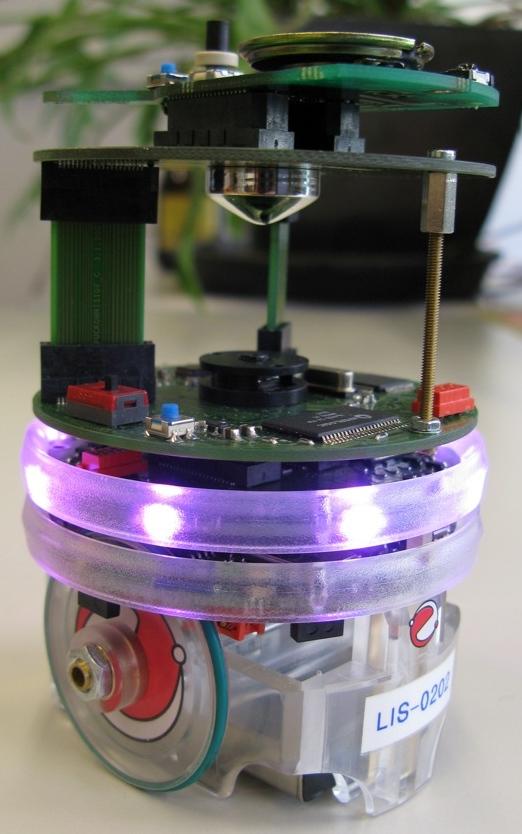
A joint research project conducted at UNIL and EPFL enabled the scientists to follow the evolution of communication in 100 groups of 20 robots over the course of 1000 generations. The robots were equipped with a camera that detected the environment, and also with wheels and a ring enabling them to emit luminous signals of different colors. Positioned in arenas, they had to locate a source of virtual food that was only visible when they came upon it. Their behavior was guided by a “neural network”, which was also controlled by genes that could evolve through mutation and selection in the course of successive generations.

An initial experiment showed that the robots rapidly acquire a communication system that enables them to transmit information about the location of the food to their peers. In fact, two really distinct communication systems evolved, according to the given populations. The simplest mechanism, using a single color to indicate the location of the food, proved more effective that the system using two colors – one pointing towards the food and the other towards the remaining part of the arena.

It also became evident that a population that has evolved towards a relatively effective type of communication doesn’t subsequently change it, as it would then be necessary to simultaneously modify the way the information is transmitted, and also the way of responding. In other words, a communication system, just like a language, cannot change rapidly through generations. In addition, this research underlines the importance of random factors in evolutionary processes. The experiment performed in twenty homogenous groups (with robots of the same type) actually shows that half of them choose the simpler – one color – strategy, whereas the other half opt for the two color system.

Competition requests more complex talking
Finally, a second experiment demonstrated that, even with robots, nothing is perfect. Within a competition context, when groups of robots were confronted with robots of other populations, it was the more complex (two-color) strategy that won the day, in spite of the proven effectiveness of the single-color strategy.

Supported by the Swiss National Science Foundation, this research has been published in the magazine PNAS (Proceedings of the National Academy of Sciences of the United States). It shows that communication strategies can evolve in different ways through generations within an identical environment.

“We know that in the animal kingdom communication systems are very complex”, concludes Laurent Keller, “and this diversity evolved over a very long period of time. Our experiment shows how it occurs, and reveals that environmental factors are not the only ones involved, as one might believe. The robots shed new light on these evolutionary processes.”


Source: École polytechnique fédérale de Lausanne (EPFL)

Additional Information:

Monday, September 19, 2011

Yale Engineers Invent a Magnetic Fluid Pump with No Moving Parts

Engineerblogger
Sept 19, 2011

Used in Hollywood and the advertising industry to create exotic special effects, ferrofluids are seemingly magical materials that are both liquid and magnetic at once. In a study published today in Physical Review B, Yale electrical engineering professor Hur Koser and colleagues from the University of Georgia and Massachusetts Institute of Technology demonstrate for the first time an approach that allows ferrofluids to be pumped by magnetic fields alone. The invention could lead to new applications for this mysterious material.

Developed in the 1960s by NASA scientists seeking a non-mechanical method for moving liquid fuels in outer space, ferrofluids are made up of magnetic nanoparticles suspended in liquids such as oil, water, or alcohol. Though numerous industrial, commercial, and biomedical applications for ferrofluids have since been created, the original goal-to pump liquids with no machinery-remained elusive, until now.

"We have shown that ferrofluids may be pumped at controllable speeds in closed-loop geometries without any mechanically moving parts," says Koser. The discovery, based on work funded in part by the National Science Foundation, is a culmination of many years of research, and is based on a theory Koser proposed in 2005 to suggest that travelling magnetic fields could enable very fast pumping of ferrofluids.

Following on successful computational simulations, the so-called "ferrohydrodynamic pumping mechanism" that Koser and colleagues have now validated could be used in systems as tiny as microfluidic devices, or as large as industrial-scale pumps, he says. It could also be used to cool computers more efficiently.

The ferrohydrodynamic pump method works when electrodes wound around a pipe force magnetic nanoparticles within the ferrofluids to rotate at varying speeds. Those particles closest to the electrodes spin faster, and it is this spatial variation in rotation speed that propels the ferrofluid forward. "We don't rely on any other material; no magnets, nothing moving but the ferrofluid that we're pumping," Koser says.

Koser and colleagues demonstrated the simplicity of this "hands-free" pumping scheme using a stereo amplifier, ordinary plumbing materials from the local hardware store, and a commercially available mineral oil/magnetite ferrofluid that is easy to make and safe to handle. "Pumping systems can be much cheaper and easier to manufacture when liquid can be moved without machinery," Koser notes.

"The ferrofluid pumping scheme we demonstrated is simple, robust, and very inexpensive," says co-author Leidong Mao, a former graduate student in Koser's lab, currently with the Faculty of Engineering at the University of Georgia. Their approach, Mao notes, could lead to highly compact, integrated, quiet, and efficient liquid cooling schemes for portable, high-performance consumer electronics. For instance, ferrofluid cooling would eliminate the need for fans and heat plumbing inside computers, enabling further miniaturization. "Your laptop could be twice as thin and a third lighter and faster with more efficient cooling," Koser says. Novel medical applications, such as cell sorting, might also be enabled by biocompatible ferrofluids, he adds.

Other co-authors include Shihab Elborai, Xiaowei He, and Markus Zahn from MIT's Laboratory for Electromagnetic and Electronic Systems. To read the paper, Direct observation of closed-loop ferrohydrodynamic pumping under traveling magnetic fields, see the current issue of Physical Review B (http://prb.aps.org/abstract/PRB/v84/i10/e104431).

Source: Yale University