Pages

Subscribe:

Ads 468x60px

Showing posts with label DARPA. Show all posts

Wednesday, January 11, 2012

Researchers seek high-pressure materials without high-pressure processes

Engineerblogger
Jan 11, 2012


Credit: DARPA

Military missions place tremendous stress on the materials used for defense weapons, vehicles and other applications. As a result, the search for stronger, lighter and more resilient materials is never ending. Some materials have proven to have high pressure phases that could yield performance improvements in a variety of defense applications provided the processes could be scaled to create stable materials in the quantities needed for the defense mission. Applications range from stronger armor, to lighter weights which allow for faster propulsion, to greater resiliency in aerospace, ground and naval platforms. DARPA’s Extended Solids program seeks to identify processes that enable stabilization and production of high pressure phase materials, without the limitations of scale introduced by current high-pressure processes, that exhibit properties far superior to those currently available for DoD applications.

“We seek the ability to access these ultrahigh pressure phases without having to use the ultrahigh pressures currently required to achieve them,” said Judah Goldwasser, DARPA’s program manager for this effort. “In the thermochemical world, the ability to synthesize the vast array of materials available both biochemically and synthetically is predicated on exploitation of multistep synthesis and stabilization strategies, so target materials can be produced through intermediates using methods and conditions mild enough to be viable.”

Through this program, DARPA seeks the development of analogous strategies that can be applied to the barochemistry, or ultrahigh pressure regime. This technology could fundamentally change the way high-pressure polymorphs/phases are synthesized, potentially opening a vast new material design space for exploitation.

Goldwasser stressed that the complex nature of this research effort requires diverse sets of skills and expertise to meet program objectives and milestones, and encouraged potential researchers to team with others to help ensure success.

To increase awareness of this program and attract potential researchers, DARPA has scheduled a Proposers’ Day workshop Feb. 9 at the Executive Conference Center, 4075 Wilson Boulevard, third floor, in Arlington, Va. This meeting is in support of the anticipated release of a Broad Agency Announcement for Extended Solids. The purpose of this workshop is to introduce the research community to this effort and its goals, explain the mechanics of a DARPA research program and the objectives and milestones of this particular effort, and encourage collaborative arrangements among potential proposers who have the required expertise, facilities and capabilities to conduct research and develop in support of Extended Solids. Proposers’ Day details are available through the Special Notice located here. Interested researchers should register soon, as participation is limited to 100 (2 people per organization). Deadline for registration is 5:00 p.m. EST Feb. 6.

Source: DARPA

Related Information:
 

Tuesday, November 29, 2011

TIME Magazine recognizes DARPA’s Hummingbird Nano Air Vehicle

Engineerblogger
Nov 29, 2011


Rapidly flapping wings to hover, dive, climb, or dart through an open doorway, DARPA’s remotely controlled Nano Air Vehicle relays real-time video from a tiny on-board camera back to its operator. Weighing less than a AA battery and resembling a live hummingbird, the vehicle could give war fighters an unobtrusive view of threats inside or outside a building from a safe distance. This week, TIME Magazine named the Hummingbird one of the best 50 inventions of the year, featuring it on the November 28th cover.

“The Hummingbird’s development is in keeping with a long DARPA tradition of innovation and technical advances for national defense that support the agency’s singular mission – to prevent and create strategic surprise,” said Jay Schnitzer, DARPA’s Defense Sciences Office director.

Creating a robotic hummingbird, complete with intricate wings and video capability, may not have seemed doable or even imaginable to some. But it was this same DARPA visionary innovation that decades ago led to unmanned aerial vehicles (UAVs), which were, at the time, inconceivable to some because there was no pilot on board. In the past two years, the Air Force has trained more initial qualification pilots to fly UAVs than fighters and bombers combined.

“Advances at DARPA challenge existing perspectives as they progress from seemingly impossible through improbable to inevitable,” said Dr. Regina Dugan, DARPA’s director.

UAVs from the small WASP, to the Predator, to Global Hawk now number in the hundreds in Afghanistan. What once seemed inconceivable is now routine.

“At DARPA today we have many examples of people – national treasures themselves – who left lucrative careers, and PhD programs, to join the fight,” Dugan said. “Technically astute, inspiringly articulate, full of ‘fire in the belly,’ they are hell-bent and unrelenting in their efforts to show the world what’s possible. And they do it in service to our Nation.”

TIME Magazine also recognized DARPA’s innovative breakthrough in 3-D holography, the Urban Photonic Sandtable Display, among its top 50 inventions. The holographic sand table could give war fighters a virtual mission planning tool by enabling color 3-D scene depictions, viewable by 20 people from any direction—with no 3-D glasses required.


Source: DARPA

Thursday, November 24, 2011

Insect cyborgs may become first responders, search and monitor hazardous environment

Engineerblogger
Nov 24, 2011


Credit: Image courtesy of University of Michigan


Research conducted at the University of Michigan College of Engineering may lead to the use of insects to monitor hazardous situations before sending in humans.

Professor Khalil Najafi, the chair of electrical and computer engineering, and doctoral student Erkan Aktakka are finding ways to harvest energy from insects, and take the utility of the miniature cyborgs to the next level.

"Through energy scavenging, we could potentially power cameras, microphones and other sensors and communications equipment that an insect could carry aboard a tiny backpack," Najafi said. "We could then send these 'bugged' bugs into dangerous or enclosed environments where we would not want humans to go."

The principal idea is to harvest the insect's biological energy from either its body heat or movements. The device converts the kinetic energy from wing movements of the insect into electricity, thus prolonging the battery life. The battery can be used to power small sensors implanted on the insect (such as a small camera, a microphone or a gas sensor) in order to gather vital information from hazardous environments.

A spiral piezoelectric generator was designed to maximize the power output by employing a compliant structure in a limited area. The technology developed to fabricate this prototype includes a process to machine high-aspect ratio devices from bulk piezoelectric substrates with minimum damage to the material using a femtosecond laser.

In a paper called "Energy scavenging from insect flight" (recently published in the Journal of Micromechanics and Microengineering), the team describes several techniques to scavenge energy from wing motion and presents data on measured power from beetles.

This research was funded by the Hybrid Insect Micro Electromechanical Systems program of the Defense Advanced Research Projects Agency under grant No. N66001-07-1-2006. The facilities used for this research include U-M's Lurie Nanofabrication Facility.

The university is pursuing patent protection for the intellectual property, and is seeking commercialization partners to help bring the technology to market.

Source: University of Michigan


Wednesday, November 16, 2011

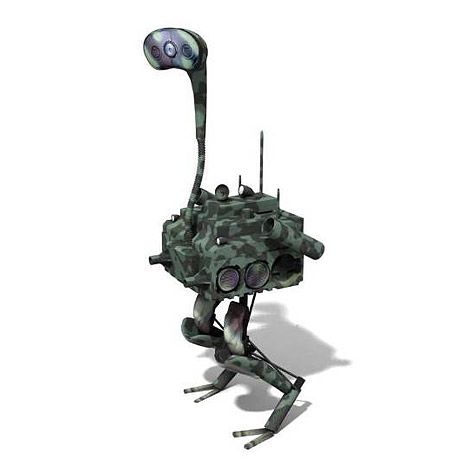
This Is What DARPA's Robot Ostrich Will Look Like

Engineerblogger
Nov 15, 2011


I'll bet you didn't know that DARPA was even interested in a robotic ostrich, did you? I sure as heck didn't. But I suppose it shouldn't be that surprising, since DARPA seems to want robotic versions of just about anything that's capable of extreme levels of performance, and an ostrich apparently fits the, uh, bill.

The above image is a rendering of the eventual form of a robot called FastRunner, a project led by the Florida Institute for Human and Machine Cognition (IHMC), in Pensacola. MIT's Robot Locomotion Group is a partner in the project. FastRunner uses a novel* leg design that should allow it to efficiently sprint at speeds of over 30 kilometers per hour while stabilizing itself and only using one actuator per leg. It'll also be able to run over moderately rough terrain, albeit at 15 km/h, which is still probably going to give even a talented human a run for their money. To put the speed of this robot in perspective, a human can sprint at about 40 km/h over short, level distances, while an actual ostrich can hit almost 100 km/h, with sustained speeds in the 70s.

So far, FastRunner consists of legs and body in simulation, plus one full-scale test leg. When completed, the robot will weigh about 30 kilograms, stand 1.4 meters high, and offer fast, efficient, and very robust motion for whatever potentially sinister applications DARPA can dream up:

IHMC has a lot of experience building legged robots. Researchers there have focused on "biologically inspired hardware design, bipedal and quadrupedal walking, balance, and push-recovery control," among other things. They've written locomotion algorithms for the LittleDog program, another DARPA initiative, and they're also developing humanoid robots for operation in urban environments and robotic exoskeletons to assist people with limited mobility.

MIT, for their part, has a whole bunch of experience with making clever robots with legs. In fact, they have (or had, at any rate) a whole lab dedicated to it. Fans of cool robots might remember this Thanksgiving-themed post from 2008, showing a robotic turkey, chicken, and dinosaur walking around MIT back in 2001. Ostriches are functionally very similar to dinosaurs and their descendants (I'm talking about birds, of course), perhaps even more so since the noble ostrich doesn't rely on its wings for much more than providing shade for smaller ostriches.

Anyway, getting back to FastRunner, it's pretty clear that these researchers have a solid foundation for the design of this robot, especially if you think about where they were 10 years ago and all the technological wonderment that's happened between then and now. My only remaining question is this: Those tubes on the sides of the robot in the rendering... Rocket launchers, or turbojets?


Source: Spectrum IEEE

Friday, November 11, 2011

DARPA AIMS TO LAUNCH SMALL SATELLITES FASTER, CHEAPER

Engineerblogger
Nov 11, 2011


Program plans to put 100-pound satellites into orbit for one-third the cost

Today there’s one way to get a satellite into space: launch it from the ground on a booster rocket, which is expensive and can take weeks or months between missions to prepare the launch pad. And a change in weather can scrap the launch at the last minute.

DARPA’s Airborne Launch Assist Space Access (ALASA) program seeks to reduce cost, time and weather constraints for launching small satellites from an aircraft.

“Current small satellite payloads can cost up to $30,000 per pound to launch, which is unsustainable over the long haul. Even when our increasingly capable small satellites are launched, they are obliged to go to orbits selected by the primary payload on current launchers, rather than to the orbits their designers and operators would prefer,” said Mitchell Burnside Clapp, DARPA program manager. “Through this program we’d like to see the cost per flight drop to less than $1 million dollars, including the range support costs, for 100-pound payloads, and to be able to launch each of those satellites into a dedicated orbit.”

The vision is for an aircraft to carry the small satellite and its host-booster either inside the aircraft or externally. At the desired altitude and direction the aircraft releases the satellite and booster, which continue their climb into space.

A key benefit of such a system is responsiveness to an immediate need. Within a day of being called up, a satellite launch mission could be conducted from a runway anywhere in the world. Another advantage is the flexibility of an aircraft to deliver a satellite into any desired orbit at any time.

Innovative technologies and techniques required for the ALASA program may include propellant systems, possible in-flight liquid oxygen production, motor case materials, flight controls, nozzle designs, thrust vectoring, throttling, mission planning techniques and airspace clearance procedures.

Source DARPA

Additional Information:

Monday, October 24, 2011

Innovators Sought for DARPA Satellite Servicing Technology Program


Engineerblogger
Oct 24, 2011

Phoenix seeks to repurpose ‘retired’ satellite components through GEO servicing

More than $300 billion worth of satellites are estimated to be in the geosynchronous orbit (GEO—22,000 miles above the earth). Many of these satellites have been retired due to normal end of useful life, obsolescence or failure; yet many still have valuable components, such as antennas, that could last much longer than the life of the satellite. When satellites in GEO “retire,” they are put into a GEO disposal or “graveyard” orbit. That graveyard potentially holds tens to more than a hundred retired satellites that have components that could be repurposed – with the willing knowledge and sanction of the satellite’s owner. Today, DoD deploys new, replacement satellites at high cost—one of the primary drivers of the high cost is the launch costs, which is dependent on the weight and volume of antennas. The repurposing of existing, retired antennas from the graveyard represents a potential for significant cost savings.


DARPA’s Phoenix program seeks to develop technologies to cooperatively harvest and re-use valuable components from retired, nonworking satellites in GEO and demonstrate the ability to create new space systems at greatly reduced cost. “If this program is successful, space debris becomes space resource,” said DARPA Director, Regina E. Dugan.

This concept will require diverse expertise from the international and nontraditional space communities. For example, today’s ground-based robotics systems allow surgeons to perform telesurgery on a patient thousands of miles away, and advanced remote imaging systems used for offshore drilling view the ocean floor thousands of feet underwater. These types of capabilities, if re-engineered for zero gravity, high-vacuum and harsh radiation, could be used in space to allow the repurposing of valuable antennas from retired GEO satellites.

“Satellites in GEO are not designed to be disassembled or repaired, so it’s not a matter of simply removing some nuts and bolts,” said David Barnhart, DARPA program manager. “This requires new remote imaging and robotics technology and special tools to grip, cut, and modify complex systems, since existing joints are usually molded or welded. Another challenge is developing new remote operating procedures to hold two parts together so a third robotic ‘hand’ can join them with a third part, such as a fastener, all in zero gravity. For a person operating such robotics, the complexity is similar to trying to assemble via remote control multiple Legos at the same time while looking through a telescope.”

To optimally use those repurposed assets, the Phoenix program will develop low-cost, scalable electronics and structural modules that would allow localized control and communication with each other and a master satellite, ala DARPA’s System F6, that together harnesses the repurposed antennas. Phoenix specifically seeks technologies for developing a new class of small “satlets,” or nanosatellites, which can be sent more economically to the GEO region through existing ride-along services with commercial satellite launches and then robotically attached to the antenna of a nonfunctional cooperating satellite to essentially create a new space system. The nanosatellites may leverage the technologies, infrastructure, protocols and architecture developed within the ongoing System F6 program.

Technical expertise is sought to design a payload orbital delivery system, or PODS, to safely house the satlets when they are launched aboard a commercial satellite.

A separate on-orbit “tender,” or satellite servicing station, is planned to be launched into GEO. Once the tender arrives on-orbit, the PODS would be released from its ride-along host and linked with the tender to become part of the satellite servicing station’s “tool belt.” The tender plans to be equipped with grasping mechanical arms and remote vision systems to remove components and satlets from the PODS using unique space tools to be developed in the program.

Critical to the success of the Phoenix program is active participation from both U.S. and international communities involved in vital technical areas such as:
  • Radiation tolerant microelectronics and memory storage. 
  • Distributed wireless mobile platform solutions for ad hoc connectivity and control.
  • Industrial electronic control systems.
  • Terrestrial microminiature guidance and control measurement units. 
  • Industrial robotics end effectors and tool changeout mechanisms and techniques. 
  • Computer-assisted medical robotics microsurgical telepresence, tools and imaging. 
  • Remote underwater imaging/vision technologies used in the offshore oil and gas drilling industry. 
  • Terrestrial manufacturing of high volume microelectronics and computer data storage. 
  • Terrestrial thermal management design technology of electronic devices and systems. 
  • Low-cost industrial manufacturing of high-volume sheet metal and other structural materials.
  • Additive manufacturing on various structural materials

Source: DARPA

Additional Information: