Pages

Subscribe:

Ads 468x60px

Showing posts with label Russia. Show all posts

Friday, December 16, 2011

The world’s largest plant producing high capacity lithium-ion batteries has been launched in Novosibirsk region

Engineerblogger
Dec 16, 2011

The world’s largest plant producing high capacity lithium-ion batteries has been launched in Novosibirsk region today. The plant belongs to the LIOTECH Company – a joint venture between Russian Corporation of Nanotechnologies (RUSNANO) and the International holding Thunder Sky Limited. The total investment in the project has amounted more than 13,5 billion rubles. The plant which overall area of production facility is over 40 000 sq. m. has been built in a record-breaking period, just in 9 months.

Alexey Homlyaskiy, the Deputy Governor of Novosibirsk Region, Anatoly Chubais, the Chairman the Board of RUSNANO, Alexander Erokhin, the CEO of LIOTECH LLC took part in the ceremony of opening of a new plant.

Using ecofriendly nanostructured cathode lithium – ferrum – phosphate material (LiFePO4), the LIOTECH Plant will output batteries with different nominal capacity: 200, 300 and 700 A*hr. As of today, this material allows to achieve the best performance of the batteries within the frame of their industrial manufacturing.

The planned capacity of new plant will amount over 1 GWh or about 1 mln. batteries per year. This enables to equip with the batteries about 5, 000 electric buses annually.

The LIOTECH lithium-ion batteries differ with high-power density, do not need secondary service and have a wide temperature range of usage. These characteristics enable us to use them widely in electrical transport, as well as in power industry as energy storage devices and uninterruptible power supplies. Moreover, after batteries have been used in electric transport, they still can be utilized as accumulators in power industry during 10-15 years more. Also, it is necessary to note that recycling of such a type of accumulators is completely safe for environment.

The fact that the LIOTECH LLC has already concluded delivery contracts for batteries before the manufacturing has been launched, emphasizes being in demand of a new product. One of the main consumers of new batteries in Russia will be the MOBEL LLC; 3 billion rubles contract has already been sighed with this company.

"The new plant is a successful example of foreign high-technologies’ transfer, allowing to create a modern manufacture, in which, after reaching full production capacity over 500 people will be employed. By implementing the program of import substitution, we will create a whole cluster of new high-tech manufacturing of related materials and components as well as an Engineering Center ", - emphasizes Sergey Polikarpov, RUSNANO Managing Director.

“Implementation of public electric vehicle equipped with lithium-ion batteries of our production will significantly improve the environment situation in large cities of Russia. Utilizing of batteries together with alternative energy sources will boost the development of "green technologies" and increase the energy efficiency of the economy of the Russian Federation. Russian Railway Company and Moscow underground rapid transport system, electricity supply network and power generation companies, military industrial enterprises as well as housing and communal services, telecommunication companies have already shown a great interest towards energy storage units of our batteries”, - notes LIOTECH CEO, Alexander Erokhin.

Source: Liotech

Friday, October 7, 2011

Russia's solar potential

Engineerblogger
Oct 07, 2011


Russia is the biggest country in the world and one of biggest suppliers of oil and gas has not yet seen a real need to develop a market for solar technologies.

This might change during the next few years - says Tomasz Slusarz, CEO of Solar PV Consulting - observing the policy and market situation on the global markets for the past 8 years and comparing it to the current situation in Russia, he is confident that cumulative solar installed capacity in Russia can reach above 1 or even 2 GW by 2020. He is even ready to bet on it. Here are his three arguments to back the claim.

Argument 1: Growing energy demand

In 2009, the Russian Energy Agency was forecasting that 51.7 GW of capacity would be decommissioned by 2020, requiring more than 150 GW of new capacity to meet consumption growth during the current decade.

I also notice a growing understanding from Russian policy makers and the private sector that increased use of renewable energy technologies can help meet the growing demand.

The Energy Strategy of Russia has set a target of 4.5% for the installed renewable electricity generation by 2020 (including small hydro up to 25 MW), which means a requirement of 22 GW for the new installed capacity.

As there are no sectorial targets within the 4.5% target, theoretically, quasi whole renewable energy capacity can be built from small hydro, wind, biomass or geothermic sources. However, in my opinion, solar PV with its more and more competitive prices can become a quite an important piece of the 22 GW cake.

Increasingly competitive prices of solar PV generation will be confronted with rapidly growing electricity prices in the country. According to the 2010 Budget of the Russian Federation, in 2020 the average electricity tariffs for all users will reach a level of 10.5cents/kWh and residential tariffs 15.3cents/kWh, compared to today's 7cents/kWh.

Argument 2: Huge investments in production capacities

Russian solar industry and RUSNANO, a state-owned fund, have invested billions of dollars in new manufacturing facilities such as Hevel Solar (thin-film PV), and Nitol (large-scale polysilicon and monosilane manufacturing).

When looking at the increasingly competitive global solar markets, they realize the urgent need to establish a sustainable domestic market in order to help the Russian industry grow and be able to compete on export markets.

Few weeks ago we heard that Russia's North Caucasus region is about to set up its own Silicon Valley with a joint venture between the regional government and private businesses. The cost of the project would be around 1 billion USD with pre-estimated production volume of 12 billion USD per year, and 2 to 7 years of return on investments.

Polycrystalline silicon production would be located in Stavropol region, with monocrystalline silicon production set up in Kabardino-Balkaria. The final production of photovoltaic cells and solar modules would be located in Karachay-Cherkessia and Dagestan respectively.

I am quite sure that if the project is successful, a lot of modules will be installed not only in the region but also all over the country.

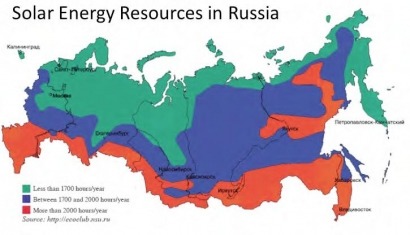
Argument 3: Russia - sunny country!

The technical potential of solar energy was estimated as 1.870 TWh, with an economic potential of around 101 GWh per year in the national report titled "Role of renewable energy sources in energy strategy of Russia".

The southern parts of Russia, especially the North Caucasus, have the greatest potential for solar energy. The Krasnodar Region and most parts of Siberia have insolation levels comparable to the south of France and central Italy while the Zabaikalsky Region gets more solar energy than Spain.

Argument 4: Big giants start to understand that solar PV can be a good business

It is worth to mention that today not only Renova group of companies, one of the largest diversified business groups in Russia, understand that solar energy can be a profitable investment.

Renova is a major shareholder of Oerlikon and controlling shareholder of Avelar Energy Group as well as a shareholder of previously mentioned Hevel Solar. It has also recently established NAVI Capital Management, a fund that is going to invest 200 million dollars in clean-tech innovation with an important focus on solar PV.

Lukoil, a major Russian oil company, in partnership with the government of Uzbekistan and the Asian Development Bank, is planning to construct Uzbekistan's largest solar plant, which will have an initial capacity of 100 MW, to expand eventually to 1 GW. Earlier this year Lukoil started to build its first 4 million dollar solar plant in Bulgaria.

These examples show that a growing number of Russian giant companies, with available financial resources, feel that investing in solar energy can be a good business strategy.

Moreover, I have heard from many companies exhibiting at 26EUPVSEC that their booths were visited by representatives from some of the biggest energy companies in Russia, which were potentially interested in investing in solar parks in Italy, Greece or Bulgaria. I am quite sure that at the end of the day these big companies will strongly support the development of a domestic solar market.

Source: Solardaily.com

Additional Information: