Pages

Subscribe:

Ads 468x60px

Showing posts with label Defense. Show all posts

Friday, January 13, 2012

Send in the Supplies: RoboCopters in Marines’ Future

Engineerblogger
Jan 13, 2012


Marines running low on ammo may one day use an app on their digital handhelds to summon a robotic helicopter to deliver supplies within minutes, enabled by technologies from a new Office of Naval Research (ONR) program.

The Autonomous Aerial Cargo Utility System (AACUS) is a five-year, $98 million effort to develop sensors and control technologies for robotic vertical take-off and landing aircraft.

“AACUS is a leap-ahead technology that allows the Navy and the Marine Corps to move beyond having a highly trained operator fly an unmanned aircraft,” said Rear Adm. Matthew Klunder, chief of naval research. “The program will let us leverage advanced autonomy, but still maintain the central and critical role of the human operator as the supervisor.”

Marines based at outposts or in the field will be able to request the autonomous cargo helicopters for rapid resupply of combat essentials.

“We want to turn any helicopter into a logistics machine,” said Dr. Mary “Missy” Cummings, program officer for AACUS, ONR’s newest innovative naval prototype. “In the near term, we want to succeed in fully-autonomous landings in austere locations, so Marines can get whatever they need on demand.

“In the long term, this could be a real life saver and revolutionize first response,” she added. While rapid resupply is the immediate focus for AACUS, long-term applications could include critical medical missions such as casualty evacuation.

Program officials are seeking researchers who will develop threat- and obstacle-detection and avoidance systems, as well as autonomous landing capabilities that can operate across different types of aircraft. They expect teams from industry and academia to join forces to compete for the contracts.

Proposals are due Feb. 22. Officials plan to award up to two contracts in April.

The effort follows the Marine Corps Warfighting Laboratory’s successful program to develop an unmanned system capable of hauling cargo semi-autonomously to landing zones at bases. The prototype, called K-MAX, flew its first combat mission in Afghanistan in mid-December, resupplying Marines with cargo carried in a sling-load.

AACUS, on the other hand, is aimed at internal load-carrying capacity. It will be a major leap ahead in autonomy, said Cummings. While K-MAX requires a trained operator within line-of-sight to fly, any operator will be able to call for AACUS from any location.

“It’s going to be designed to work with people who have no flight experience,” she said. “An operator will pick up his iPad or Android and make an emergency supply request. He’ll request that the helicopter come to him and land as close to him as possible.”

The helicopter not only will take off by itself, but will plan its own flight path and navigate its way through the airspace, requiring little to no input from an operator other than to verify its proposed landing site. The concept will require improvement in data processing.

“How you take the data from sensors and integrate them to make these decisions—that’s one of the big leaps,” said Cummings. “It’s like putting a frontal lobe on the helicopter.”

For more information on submitting proposals, review the AACUS broad agency announcement (12-004).

Source:  Office of Naval Research 

Related Information:

Tuesday, January 3, 2012

K-MAX unmanned helicopter makes first cargo delivery

Engineerblogger
Jan 3, 2012


K-MAX is the Marine's first unmanned helicopter.  Photo courtesy of Lockheed Martin

A new era in unmanned aviation began earlier this month when Marine Unmanned Aerial Vehicle Squadron 1 operated a K-MAX unmanned helicopter during its historic 90-minute flight, Dec. 17. K-MAX is the Marine's first unmanned helicopter designed for resupplying troops in remote locations. During its maiden flight, K-MAX successfully delivered about 3,500 pounds of food and supplies to troops at a forward operating base in Afghanistan without risk to a pilot.

Source: NAVAIR


Related Information:


Monday, December 12, 2011

Research may yield more compact antennas for military use

Engineerblogger
Dec 12, 2011


Nader Behdad


While tall, bulky antennas seem like relics in an era of sleek, modern smartphones, they're still an unfortunate necessity for American soldiers.

"One of the problems that many military communications systems have is that they use low frequencies — anywhere from 2 MHz to below 1 GHz," says Nader Behdad, an assistant professor of electrical and computer engineering at the University of Wisconsin-Madison. "As a result, very often you see huge antennas sticking off of their vehicles."

Behdad thinks that those enormous antennas could be scrapped for low-profile, broadband antennas — thanks to a different approach to antenna design that replaces large dipole antennas with a more compact and conformal multi-mode radiator.

The Office of Naval Research agreed, giving Behdad a three-year, $510,000 research award through its young-investigator program, allowing him to develop the next generation of antennas for its vehicles.

With traditional dipole antennas, the lower the operating frequency of an antenna, the larger it needs to be. Rather than fighting the laws of physics and trying to lower the operating frequency of a single antenna, Behdad's concept involves tuning multiple parts of the same antenna structure to radiate at different frequencies, using synthetic "metamaterials" to shape their radiation patterns so that they won't interfere with one another. Composed of metals, dielectrics and other materials, metamaterials react to electromagnetic waves differently, based on their index of refraction, making it possible to manipulate two competing radiation patterns and make them work in tandem within one antenna.

Behdad estimates that an antenna with dimensions of 20-by-20-by-3 centimeters could operate anywhere between 200MHz and 40GHz in a design that could be flush with the vehicle's surface. That combination of small size and a wide band of available frequencies makes Behdad's antenna design ideal for future military communications platforms, which will involve small and large devices operating over a wide range of frequencies.

But the implications for the military are even more important than preparing for a more connected future: Eliminating the large antennas from their communications equipment could also make U.S. soldiers safer.

"If you have something like a huge antenna sticking out of a soldier, it paints a pretty big target on them as they walk in the street," says Behdad.

Despite its very specific end goal, Behdad's project has much broader commercial implications. "Any wireless application that uses different, widely varying frequency bands could potentially benefit from this technology," he says.

Ultra-wideband wireless technology — which could power the next generation of wireless video and data connections for personal computers — could benefit greatly from the technology, as could telecommunications companies that will be looking for ways to best use the low-frequency bands that were vacated in the changeover to digital television.

Giving up those tiny, sleek smartphones for bulky UWB antennas isn't especially palatable for consumers, and Behdad's antenna concept could be the answer to a coming design problem in the cellphone industry. "

"If you want to have a cell phone that works in these frequencies of 600 MHz or 300MHz, having compact antennas that are broadband would be useful," he says.

Source:  University of Wisconsin-Madison

Wednesday, December 7, 2011

New Material's Capability to Increase Weapons' Explosive Force Demonstrated at Navy Test Range

Engineerblogger
Dec 7, 2011


Military, government and industry officials watched the demonstration of a revolutionary material that increases the explosive force and lethality on enemy targets during a test at Naval Surface Warfare Center (NSWC) Dahlgren, Va., Dec. 2.

The test material, called High-Density Reactive Material (HDRM), is designed to replace steel in warhead casings with little or no compromise in strength or design.

“Today’s test demonstrates this new material’s potential and the ability of NAVSEA Warfare Center engineers and scientists to move it from the laboratory to full scale working prototype in under a year to meet technology development goals,” said NSWC Dahlgren Division Commander Capt. Michael Smith. “It’s a remarkable achievement that could not have been accomplished without close technical collaboration and effort between the Office of Naval Research (ONR), NSWC Dahlgren, NSWC Indian Head Division and industry.”

Navy scientists and engineers from NSWC Indian Head Division (IHD) developed HDRM by combining several metals and using standard manufacturing processes.

"It's rewarding to see the validation of much of the theory and experimentation that led to the final material selection,” said Dr. Clifford Bedford, ONR Advanced Energy Materials program manager. “In the applied research phase of the program, we’ve seen 100 percent reproducibility with this experimental system.”

Unlike conventional munitions, the innovative materials approach integrates the casing with warhead explosives for increased lethality.

“HDRM has demonstrated enhanced blast, multiphase blast, and reactive fragments effects,” said Dr. Jason Jouet, NSWC Indian Head Reactive Materials team lead. “With the strength of aluminum, density of steel, and more than one and a half times the energy of TNT, HDRM is truly a revolutionary enabling technology.”

HDRM can readily replace steel in existing systems and is compatible with current warhead designs, thereby maintaining the same probability of a successful target strike.

“This approach may translate to less ordnance and ultimately fewer sorties to get the same result,” said Jouet.

NSWC IHD’s Reactive Materials Team has gradually scaled up its HDRM tests to gather measurable data on the materials destructive characteristics.

"Initially, small cylinder casings were tested to help us refine the design," said Bedford. "We used that data to fine-tune the parameters which were used to scale the charge in the later test demonstrations like the test conducted today."

NSWC Dahlgren engineers worked carefully with device characteristics provided by their NSWC Indian Head counterparts and with target characteristics to design a complex test arena at NSWC Dahlgren’s Explosive Experimental Area.

“Rather than dynamically flying the HDRM ordnance device at a single target, we set up several tactically relevant targets,” said Jeb Brough, NSWC Dahlgren technical and programmatic lead for Reactive Materials. “We inspected damage to the targets and collected performance data that will be applied to effectiveness models for specific weapons.”

Test instrumentation captured critical data and NSWC Dahlgren lethality engineers are currently assessing the target damage to judge the effects of the unique HDRM device.

"Although the arena is extremely complex, it is a cost effective method of evaluating the new material's capability and potential," said Brough. "With this data, the Office of Naval Research can evaluate the best potential for further development related to a specific weapon system."

Source:  Office of Naval Research (ONR)

Monday, December 5, 2011

ONR Helps Undersea Robots Get the Big Picture

Engineerblogger
Dec 05, 2011
 
The Office of Naval Research conducts Autonomous Underwater Vehicle operations aboard the USNS Sioux off of San Clemente Island in the Pacific Ocean in September 2010. Recently ONR-sponsored scientists completed sea tests of new control software that makes underwater robotic vehicles smarter at autonomously surveying large swaths of ocean. Credit: US Navy photo by John F. Williams/Released


Scientists have successfully transitioned fundamental research in autonomy to undersea gliders, demonstrating in recent sea tests how the new software, sponsored by the Office of Naval Research (ONR), can help robots become smarter at surveying large swaths of ocean.

“Using the new algorithms, the vehicle has a greater ability to make its own decisions without requiring a human in the loop,” said Marc Steinberg, program officer for ONR’s Adaptive Networks for Threat and Intrusion Detection or Termination (ANTIDOTE), a multi-disciplinary university research program.

With plans to deploy squadrons of air, surface and undersea robotic vehicles later this decade, the Department of the Navy is investing in basic research programs to improve autonomous system capabilities.

“Advancing autonomy for unmanned systems allows you the ability to do things that wouldn’t be practical otherwise because we don’t have enough warfighters or communication today,” said Steinberg, who works in ONR’s Naval Air Warfare and Weapons Department. “If you incorporate some intelligence on the vehicles that can solve complex mission problems, then we can enable wholly new capabilities that can be achieved with limited numbers of people and communications in complicated, dynamic environments.”

ONR provided funding to researchers at the Massachusetts Institute of Technology (MIT) and University of Southern California (USC) to advance the intelligence of autonomous vehicles under both ANTIDOTE and a related university program called Smart Adaptive Reliable Teams for Persistent Surveillance. They developed a persistent surveillance theory that provides a framework for decision-making software that maximizes a robot’s collection of information over a given area. It gives some guarantees on performance in dynamic environments.

“The ability to do surveillance that takes into account the actual conditions of the environment brings a whole new level of automation and capability,” said Dr. Daniela Rus, co-director of MIT’s Computer Science and Artificial Intelligence Laboratory Center for Robotics. “We have come up with a solution that lets the robot do local reasoning to make decisions and adjust the path autonomously without having to come up to the surface to interact with humans.”

The scientists produced an algorithm that incorporates both the user’s sensing priorities and environmental factors, such as ocean currents, into a computer model to help undersea robots conduct surveys and mapping missions more efficiently.

Tests proved the benefits of using the new algorithm. The scientists conducted two separate experiments using underwater robots called gliders, operated by oceanographers. They used two gliders, one with the algorithm and one without, to measure whether the experimental technology yielded better maps of algae blooms and other underwater phenomena in the Pacific Ocean.

“In areas where the oceanographers wanted more information, the persistent surveillance algorithm actually produces more detail,” said Dr. Gaurav S. Sukhatme, ANTIDOTE’s principal investigator and director of USC’s Robotic Embedded Systems Lab. “The system can automatically figure out how to divide its time between areas that are more interesting and areas that are less interesting.”

The algorithm helps the gliders decide when to spend more time looking at regions that have changes in activity or environmental factors. Without the control algorithm, gliders paid equal attention to all areas and acquired less information during the experiments in Monterey Bay, Calif., and along the southern coastal waters near Los Angeles in October and November 2010. The first experiment lasted a period of three weeks; the second ran for two weeks. A third experiment in August 2011 took place in the Southern California Bight for 10 days. Results of the single-glider test are being analyzed.

Though the gliders were an ideal first test of the persistent surveillance theory and algorithm, the software is applicable to many different machines and robots, the scientists said.

Source:  Office of Naval Research

Tuesday, November 29, 2011

TIME Magazine recognizes DARPA’s Hummingbird Nano Air Vehicle

Engineerblogger
Nov 29, 2011


Rapidly flapping wings to hover, dive, climb, or dart through an open doorway, DARPA’s remotely controlled Nano Air Vehicle relays real-time video from a tiny on-board camera back to its operator. Weighing less than a AA battery and resembling a live hummingbird, the vehicle could give war fighters an unobtrusive view of threats inside or outside a building from a safe distance. This week, TIME Magazine named the Hummingbird one of the best 50 inventions of the year, featuring it on the November 28th cover.

“The Hummingbird’s development is in keeping with a long DARPA tradition of innovation and technical advances for national defense that support the agency’s singular mission – to prevent and create strategic surprise,” said Jay Schnitzer, DARPA’s Defense Sciences Office director.

Creating a robotic hummingbird, complete with intricate wings and video capability, may not have seemed doable or even imaginable to some. But it was this same DARPA visionary innovation that decades ago led to unmanned aerial vehicles (UAVs), which were, at the time, inconceivable to some because there was no pilot on board. In the past two years, the Air Force has trained more initial qualification pilots to fly UAVs than fighters and bombers combined.

“Advances at DARPA challenge existing perspectives as they progress from seemingly impossible through improbable to inevitable,” said Dr. Regina Dugan, DARPA’s director.

UAVs from the small WASP, to the Predator, to Global Hawk now number in the hundreds in Afghanistan. What once seemed inconceivable is now routine.

“At DARPA today we have many examples of people – national treasures themselves – who left lucrative careers, and PhD programs, to join the fight,” Dugan said. “Technically astute, inspiringly articulate, full of ‘fire in the belly,’ they are hell-bent and unrelenting in their efforts to show the world what’s possible. And they do it in service to our Nation.”

TIME Magazine also recognized DARPA’s innovative breakthrough in 3-D holography, the Urban Photonic Sandtable Display, among its top 50 inventions. The holographic sand table could give war fighters a virtual mission planning tool by enabling color 3-D scene depictions, viewable by 20 people from any direction—with no 3-D glasses required.


Source: DARPA

Friday, November 18, 2011

Micro-cavity arrays: Lighting the way to the future

Engineerblogger
Nov 18, 2011


A research team funded by the Air Force Office of Scientific Research has pioneered the use of micro-plasmas in a revolutionary approach to illumination. Just as in a fluorescent light, a micro-cavity array is energized by an applied voltage. By successfully confining that plasma in parallel rows of micro-cavities within thin sheet materials, Drs. Gary Eden and Sung-Jin Park of the University of Illinois, Urbana-Champaign, ultimately arrived at various implementations of micro-plasma arrays, which result in inexpensive, wafer-thin, and very flexible sheets of light. Credit: Courtesy of Eden Park Illumination


It was not too long ago that basic science lectures began with the three forms of matter: gases, liquids and solids—and somewhere along the line plasmas were occasionally added to the list. But to be precise, a plasma is an ionized gas; thus, a subset of the big three. But this subset has coexisted with the other forms since the Big Bang and actually makes up 99 percent of the universe. It is found in our Sun and all the other stars, and in more down to earth applications: in neon signs, Plasma TVs, Cathode Ray Tubes, and the ubiquitous fluorescent light.

It is now also found in a new form of lighting. A research team funded by the Air Force Office of Scientific Research has pioneered the use of micro-plasmas in a revolutionary approach to illumination, and Drs. Gary Eden and Sung-Jin Park of the University of Illinois, Urbana-Champaign, have founded Eden Park Illumination, Inc. to bring this new lighting technology to the world.

As is the case with many basic research endeavors, Dr. Eden did not set out to make a better light bulb—it was a query from two graduate students that showed the way. Dr. Eden explains: "In 1996 the students approached me with, literally, a block of silicon, and they said, 'do you mind if we drill a small hole in this and try to produce a plasma inside the hole?' In short order they produced a plasma inside a hole with a diameter of about 400 microns, a crude forerunner of the current micro-cavity array lighting system."

What made this fortuitous discovery interesting to Dr. Eden was the issue of space and pressure. A fundamental rule for stable, steady state plasmas is pressure times diameter scaling, the smaller the plasma dimensions, the higher the pressure can be. The very high pressures that can thus be obtained in micro-plasmas give rise to unique lighting and other properties. It is at this point that the "eureka" lightbulb (or in this case—microplasma array (MCA)—literally turned on.

Just as in a fluorescent light, a micro-cavity array is energized by an applied voltage. By successfully confining that plasma in parallel rows of micro-cavities within thin sheet materials, Eden and Park ultimately arrived at various implementations of micro-plasma arrays, some of which result in inexpensive, wafer-thin, and very flexible sheets of light.

The key to these light arrays are the micro-cavities which are formed within the flexible sheets. In one of the most important implementations, the one being developed by Eden Park Illumination, a sheet of aluminum foil is placed in an anodizing bath. By controlling the bath parameters, its temperature, and the time of anodizing, large arrays of micro-cavities can be formed with near optimum shape and with automatically placed interconnecting aluminum electrodes. The largest array thus far contains a quarter million luminous micro-cavities. Thin laminated films on the surface of the wafer contain the electrical power interconnects which feed the individual cavities. When A/C power is supplied through the almost invisible grid, the array bursts to life.

Many gases can be used to make the micro-plasma arrays. In Eden Park's commercialization processes, rare gases produce ultraviolet light, and specialty phosphors convert the UV into visible light, as in fluorescent lamps.

The largest arrays currently being produced are six inches square. These can be conveniently tiled together, in different colors if desired, to make larger arrays, and if desired, much larger arrays can be made, limited only by the size of the anodizing bath. Conveniently, aluminum foil is used, with a thickness of 125 microns (5/1000ths of an inch). The cavities are then sealed in very thin sheets of glass resulting in an array that is one to two millimeters thick.

The Eden Park plasma arrays are ruggedized to a certain extent and have an ultimate thickness of about four millimeters, leaving you with a wafer that weighs less than 200 grams.

But is this a revolutionary advance? The advantages compared to contemporary lighting technologies are quite impressive: the first thing to note is that the array is flat—a major contributor to efficiency. All one has to do is compare the six inch by six inch (by four millimeter thick) size of a micro-cavity array to a standard fluorescent office light. The fluorescent light tube—which derives its light from a mercury plasma—has a stated efficiency of about 75 to 80 lumens per watt, but much of this is lost due to its 360 degree design. By comparison, the utilization efficiency of the MCA is over 90 percent; as such, a 35 lumen per watt array has the same output as its much larger fluorescent cousin.

A further advantage: the MCA does not contain mercury—an environmental advantage. In addition, the array is fully dimmable while fluorescent lighting is not.

Color is also a factor. The Color Rendering Index (CRI), by which the varying representation of color is brought forth with different lighting systems, is also a plus. On the CRI scale the sun is a perfect 100—the yardstick by which all lighting is measured. With a CRI of over 80, the MCA approaches sunlight quality.

What also makes this light unique is that from the beginning it was designed to be fully recyclable—the plastic, glass, and aluminum contents are not only easily repurposed, but it takes very little energy to do so.

How long do these arrays last? The specification for currents arrays is currently 20,000 hours before failure.

But what about a comparison with LEDs? While the efficiency of the MCA does not quite measure up to that of LEDs, there is a positive side, that being a huge difference in thermal dissipation. MCAs generate far less heat and therefore do not require an aluminum heat sink as LEDs do, thus, MCAs not only run much cooler, but are much lighter as well.

With so many advantages, there must be a downside. Well, yes and no.

Let's consider cost: Even though all the MCA materials are inexpensive, current rate of production has not yet made the cost competitive with current lighting options. But there is light at the end of the tunnel: Congress has mandated that incandescent lights be phased out beginning in 2014; this opens up the field to a much wider acceptance of MCA technology and its application.

Micro-plasma arrays have applications in general and specialized lighting. They can be prepared to light up as a single broad light source or can be individually addressed for display type applications. Special applications might include aircraft cockpit lighting and displays due to less weight, size and heat, as well as the flexibility to conform to cramped interior spaces. Tanks and other combat vehicles would offer an ideal application for the same reasons—not to mention the absence of mercury—a hazard given the rough operating environment. Car interiors could become a customized light show unto themselves. Interior lighting for homes and offices could be transformed given the flexibility of the technology. Even the lowly refrigerator light could be in line for an upgrade.

Another surprising capability of micro-cavity plasmas is their inherent characteristic of an enormous amount of power being delivered per unit volume at high pressure, while they remain perfectly stable and benign. What does this mean in practical terms? It is a technology not only well suited for light production, but is ideal for "on-chip" special chemistries. Also by utilizing the linear micro-channel design, as employed in an MCA lighting panel, one can place a large number of parallel receptors within a small area to perform a variety of sensory activities, depending on the chemical composition within the cavities.

One such capability is the generation of ozone (O3) for water purification. Early tests demonstrate a high degree of uniform ozone producing discharges comparable to the best values currently available by commercial means. This portends a huge advantage with regard to water purification efforts in community systems when compared to the use of chlorine with its inherent environmental drawbacks —the ozone process is completely benign, as it shortly reverts back to its native oxygen (O2) state. Microplasma ozone generation also has important potential for producing small, portable ozone water purification systems, impossible now because of the inefficiency of existing technology.

Micro-cavity arrays have much to offer—the future just has to catch up.

Source: Air Force Office of Scientific Research

Research in Microscale Heat Transfer Promises to Benefit Military Systems

Engineerblogger
Nov 18, 2011

Graduate student Huarui Sun performs sensitive measurement ofinterfacial thermal transport using an ultrafast laser system. (Credit:Abhishek Yadav)

 A two-year-old Air Force Office of Scientific Research Multidisciplinary University Research Initiative effort involving the University of Michigan, Stanford University, Brown University, and the University of California at Santa Cruz is making great strides in achieving a fundamental understanding of heat transfer at interfaces.

"We aim to accomplish this by applying state-of-the-art techniques from several disciplines to arrive at a set of design rules for engineering interfaces with desired thermal properties," said Dr. Kevin Pipe, a professor of Mechanical Engineering at the University of Michigan who is leading the project.

Heat transfer is important to the performance, power requirements, and reliability of many military and commercial systems including thermoelectric refrigerators, waste heat recovery systems, heat sinks, power electronics, thermal barrier coatings, and thermal interface materials.

"Recent advances in nanoscience have enabled the precise control of interface physical and chemical structure, but the fundamental physics that link this nanoscale structure with thermal transport is not yet well developed, inhibiting the engineering of interfaces with radically enhanced thermal properties," said Pipe.

Interfaces can decrease a composite material's thermal conductivity by scattering the acoustic waves that are the primary carriers of heat in solids.

"This scattering process gives each interface a thermal resistance," said Pipe.

The researchers have made a number of achievements during the first two years of their research effort, including the development of a high-speed thermal imaging system and a technique to measure the propagation of phonons, the elementary packets of vibrational energy that carry heat, with high signal-to-noise ratio. Using ultrafast laser systems that emit laser pulses less than 50 femtoseconds in duration, Pipe's team creates high-frequency acoustic waves at the surface of a material and in a process similar to medical ultrasound imaging measures how these waves scatter off of buried interface structures.

"In one of our measurements," said Pipe, "we use picosecond x-ray pulses to look directly at atomic motion near an interface as heat flows across it."

By applying precise nanofabrication techniques to create interfaces with known atomic structure, the researchers are able to link measured heat transfer properties with the predictions of atomistic simulations to yield further understanding of the fundamental processes involved.

"By advancing the state-of-the-art in these techniques, we aim to fully characterize an interface and achieve a complete understanding of what controls the flow of heat across it," said Pipe.

"The Michigan MURI led by Professor Kevin Pipe is making extraordinary breakthroughs to understand nano-scale thermal transport by precisely tailoring interfaces using advanced processing techniques and innovative experimental laser based methods to delineate phonon modes participating in the heat transport," said Dr. Kumar V. Jata, Thermal Sciences, AFOSR, Arlington, Va. and Materials Science, Asian Office of Aerospace Research and Development, Tokyo, Japan. "In the past we never paid attention to the interfaces and considered them as either perfect or imperfect, one or the other."

Source: The Air Force Office of Scientific Research

Wednesday, November 16, 2011

Robotics in Security and Military Applications

Robotics Online
Nov 14, 2011


Robotics have been a staple of advanced manufacturing for over half a century. As robots and their peripheral equipment become more sophisticated, reliable and miniaturized, these systems are increasingly being utilized for military and law enforcement purposes.

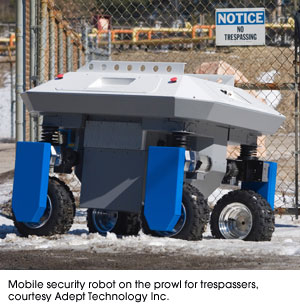
“Military and battlefield applications continue to grow at an accelerated pace due to demand fueled by government investment. Over the past decade, we have seen increasing levels of investment in autonomous vehicles used for surveillance and security,” says Rush LaSelle, Vice President and General Manager with Adept Technology Inc. (Pleasanton, California) “Applications range from monitoring perimeters of secured areas such as airports to acting as a night watchman.”

Robots go to War

Mobile robotics play an increasingly important role in military matters, from patrol to dealing with potential explosives. “With suitable sensors and cameras to perform different missions, mobile robots are operated remotely for reconnaissance patrol and relay back video images to an operator,” says Dr. Andrew Goldenberg, PhD, Chief Executive Officer and President of Engineering Services Inc. (ESI, Toronto Ontario, Canada) “Robots can neutralize suspicious objects that may explode. The platform has a robot arm to pick up explosives or suspected hazards in military or civilian settings.”

Goldenberg goes on to say, “The mobile robotic platform is mounted on a rectangular box with electronic equipment. The platform moves on wheels or tracks, or both, and is usually battery-powered. Communication equipment and sensors can detect images, sounds, gases and other hazards. The communication systems read sensors and relay that information to the operator.”

According to Goldenberg, the United States military recently began equipping mobile robotic platforms to carry small and medium-size firearms.

Robotics help meet challenges posed by the specter of urban terrorism. “Instead of having people get close to hazards such as unattended objects or car bombs, robots are used. If an operator concludes a dangerous object might explode, the robot could neutralize that object by shooting to detonate it,” Goldenberg says. “Mobile robots detect and explode in-ground mines or improvised explosive devices.” These same mobile robotic systems are used for neutralizing or exploding forgotten ordnance and mines after conflicts cease.

Likewise, LaSelle says, “Government acts as a catalyst for these applications due to the heavy investment after the terrorist attacks of September 11, 2001. Security and patrol functionalities have extended into the private sector. Companies invest in autonomous vehicles to monitor warehouses, factories, and office spaces. These sentinel applications provide users with the ability to monitor a variety of conditions such as motion, intrusion, water ingress, and temperature.”

Keeping tabs on temperature is of special importance to server farms and other sensitive electronic systems, LaSelle says. “A key area of activity for mobile robotic platforms is patrolling vacant properties and warehouses due to the reliability and low costs attributed to autonomous vehicles,” adds LaSelle.

Goldenberg’s and LaSelle’s portrayals of tasks carried out by mobile robotic platforms is echoed by Sean Thompson, Applications Engineer with MICROMO. (Clearwater, Florida) “Ground-based systems use robotics for surveillance. These platforms are equipped with weapons and cameras.” Thompson dubs some reconnaissance robots as “throw-bots,” saying these systems are “Small and light robots, robust enough to throw through a window or doorway. The robot is equipped with a camera to see within a building without sending in people.” If the structure is without light, the mobile platform’s camera is equipped with infrared or night vision, Thompson says. Another less conventional robotic application is a small reconnaissance aircraft transported by backpack. “A soldier throws small reconnaissance aircraft into the air which takes off and recover themselves.”

Additionally, Thompson says mobile robotics assist military personnel transport equipment in the field. “In military applications, wearable robotics help soldiers carry a heavy pack load. A robot acts like a pack mule, is fully autonomous, and carries a large amount of supplies.”

Thompson speaks of robotics to help inspect and maintain nuclear weapons. “Mobile robotic systems inspect nuclear missiles. Commonly, such inspection systems were large, requiring several people in protective suits going into containment systems. Now, smaller self-guided robotic systems require only one person in a protective suit going to a certain point and letting the robot go.” The robot is remotely operated outside the containment system, reducing the number of people and the amount of time people are exposed to relatively high radiation levels, Thompson concludes.
To read more click here...


Tuesday, November 1, 2011

The US Navy's Electromagnetic Railgun Reaches Testing Milestone

Engineerblogger
Nov 1, 2011


Without the need for dangerous explosives storage and handling, the Electromagnetic Railgun can potentially reach targets 20 times farther than conventional weapons.


The U.S. Naval Research Laboratory Materials Testing Facility demonstrated, Oct.31, the one-thousandth successful firing of its Electromagnetic Railgun, reaching a materials testing milestone in the weapon's technological development and future implementation aboard U.S. Navy warships.

"This test demonstrates continued advances in armature development, rail design, and barrel materials used in high power railgun launch," said Dr. Robert Meger, head, NRL Charged Particle Physics Branch. "Firing up to 15 shots per week on the laboratory's experimental railgun, researchers at NRL perform detailed testing and analysis of rails and armatures, providing S&T expertise to the Navy program that is directly applicable to tests at large-scale power levels."

Many of the 1000 shots taken on the Materials Testing Facility railgun have been designed to test different barrel designs and to quantify damage generated during high power launch. The innovations and understanding generated by NRLs' S&T program have been fed directly into the Office of Naval Research's Electromagnetic Railgun program and transferred to full-scale tests conducted at the Naval Surface Warfare Center, Dahlgren, Va.

A railgun is a form of single turn linear motor. Magnetic fields generated by high currents driven in parallel conductors, rails, accelerate a sliding conductor, known as an armature, between the rails. The velocity generated by the system is limited by rail strength and armature materials and their response to the high currents and extreme pressures generated during launch.

At launch, heat deposited in the armature and near the surface of the rails due to high currents and friction, or. viscous heating generated at the sliding interface, leads to temperatures sufficient to melt most metals including the armature material. If the heating and extreme pressures also damage the rail surface, it can destroy the contact surface and condemn the gun barrel. NRL S&T research has pioneered multiple barrel and armature designs that minimize or mitigate this damage even during successive high power launches.

First fired March 6, 2007 at a magnitude of 0.5 megajoules, the railgun system at NRL has been modified and enhanced over the last four years to operate routinely at a 1.5 megajoule launch energy - a megajoule is a measurement of kinetic energy associated with a mass traveling at a certain velocity. In simple terms, a one-ton vehicle moving at 100 mph has approximately one megajoule of kinetic energy.

"A railgun weapons system must be able to launch hundreds of projectiles and withstand extreme pressures, currents and temperatures," said NRL Commanding Officer, Capt. Paul Stewart. "Today's firing of the one-thousandth shot demonstrates Navy researchers are steadily progressing toward achieving that goal, developing a more effective and efficient future ship combat system."

The Railgun Materials Testing Facility railgun focuses on materials issues for a major Navy effort to develop a long-range, electromagnetic launcher for a future electric ship. The NRL Plasma Physics Division conducts a broad program in laboratory and space plasma physics and related disciplines, high power lasers, pulsed-power sources, intense particle beams, advanced radiation sources, materials processing, and nonlinear dynamics.


Source: Naval Research Laboratory (NRL)

Boston Dynamics: The PETMAN robot

Engineerblogger
Nov 1, 2011


Petman is an anthropomorphic robot for testing chemical protection clothing used by the US Army. Unlike previous suit testers, which had to be supported mechanically and had a limited repertoire of motion, PETMAN will balance itself and move freely; walking, crawling and doing a variety of suit-stressing calisthenics during exposure to chemical warfare agents. PETMAN will also simulate human physiology within the protective suit by controlling temperature, humidity and sweating when necessary, all to provide realistic test conditions.


Natural, agile movement is essential for PETMAN to simulate how a soldier stresses protective clothing under realistic conditions. The robot will have the shape and size of a standard human, making it the first anthropomorphic robot that moves dynamically like a real person.

The development program has a 13 month design phase followed by a 17 month build, installation and validation phase, with delivery of the robot taking place in 2011. Boston Dynamics' partners for the program are Midwest Research Institute (MRI), Measurement Technologies Northwest, Oak Ridge National Lab as well as Smith Carter CUH2A (SCC) and HHI Corporation who will construct the chamber. The work is being done for the US Army PD-CCAT-TI.

Source: Boston Dynamics


Thursday, October 27, 2011

The world's first spherical flying machine

Engineerblogger
Oct 27, 2011


Announced last summer by the Technical Research and Development Institute at Japan's Ministry of Defense (JMD) and recently unveiled at Digital Content Expo 2011. The world's first spherical flying machine will likely be deployed in search and rescue operations deemed unsuitable for traditional aircraft. As for other possible uses, the sky just may be the limit.

This machine can hover like a helicopter, and take-off and land vertically. But because it works like a propeller plane standing vertically, it can fly forward at high speed using wings, which a helicopter can't do. This machine also has three gyro sensors, so even if it hits an obstacle, it can maintain its attitude and keep flying through automatic control.

"Because the exterior is round, this machine can land in all kinds of attitudes, and move along the ground. It can also keep in contact with a wall while flying. Because it's round, it can just roll along the ground, but to move it in the desired direction, we've brought the control surfaces, which are at the rear in an ordinary airplane, to the front."

"In horizontal flight, the propeller provides the propulsive force, while the wings provide lift. For the machine to take off or land in that state, it faces upward. When it does so, the propeller provides buoyancy. At that time, too, the control surfaces provide attitude control. After landing, the machine moves along the ground using the control surfaces and propeller."

"In our aircraft R&D, we have a plane that can stand up vertically after flying horizontally. But the problem with that plane is, take-off and landing are very difficult. As one idea to solve that problem, we thought of making the exterior round, or changing the method of attitude control. That's how we came up with this machine, to test the idea."

"All we've done is build this from commercially available parts, and test whether it can fly in its round form. So its performance as such has absolutely no significance. But we think it can hover for eight minutes continuously, and its speed can go from zero, when it's hovering, to 60 km/h."

This flying machine weighs 350 g, is 42 cm in diameter, and is made of commercially available parts costing a total of around US$1,400. As it can take off and land anywhere, it's hoped that this machine will be able to reach places that were hard to access by air before, for use in rescue and reconnaissance.

Source: Diginfo.tv

Wednesday, October 12, 2011

Eurocopter develops the world’s first flight of a hybrid helicopter combining an internal combustion engine and an electric motor

Engineerblogger
Oct 12, 2011


Eurocopter has successfully tested a hybrid helicopter that combines a turboshaft internal combustion engine with an electric motor for a world premiere, marking a new milestone in its innovation roadmap that opens the way for further enhancements in rotary-wing aircraft safety.

For this initial breakthrough in exploring the hybrid concept, Eurocopter is using the supplemental electric system to increase maneuverability of a single-engine helicopter during an autorotation landing – which is performed by helicopters in the event of a main engine failure.

The demonstrator helicopter is a production version of Eurocopter’s highly successful light single-engine AS350, which has been equipped with a supplementary electric motor. In the event of an engine failure, the electric motor provides power to the rotor, allowing a pilot to control the helicopter very easily during the descent to a safe touchdown. The next step is to bring this concept to maturity and evaluate its implementation on Eurocopter’s series production helicopters.


“Eurocopter’s research and development efforts are used every day to push the frontiers by increasing helicopter safety and performance for the benefit of our customers, and we are proud to have brought the first helicopter equipped with an internal combustion engine and electric propulsion system to flight,” said Lutz Bertling, Eurocopter President and CEO. “Hybrid propulsion is an important element of Eurocopter’s innovation roadmap in developing the next generation of helicopters. It offers new opportunities for improvements in safety, along with the potential for reducing fuel consumption and emissions.”

The AS350 hybrid demonstrator has its highly compact electric motor and lithium ion polymer battery installed in the center area of the helicopter. Electronic controls enable precise deployment of power delivered by the electric motor during the period of autorotation.

Eurocopter’s AS350 is one of the most successful helicopters, with the more than 4,000 aircraft in service worldwide having logged more than a million flight hours as of 2010. It excels in hot conditions and very high altitudes, holding the record as the only helicopter to have landed on top of Mount Everest.

Source: EADS

Friday, October 7, 2011

The Recon Scout Throwbot miniature mobile robot

Engineerblogger
Oct 07, 2011

Under a contract worth $4.8m (£3.1m) from the US Army Rapid Equipping Force, ReconRobotics will supply 315 Recon Scout XT micro-robot kits and an equal number of SearchStick devices.

According to ReconRobotics, the SearchStick enables soldiers to convert any Recon Scout Throwbot into a pole camera, which can then be used to see over compound walls, onto rooftops and into culverts. The company plans to complete deliveries of these micro-robot systems by 31 October 2011.

Recon Scout XT micro-robots are reportedly deployed at the fire-team level — one robot for each four- to six-man fire team — to maximise situational awareness and standoff distance during route — and compound-clearing operations.

The Recon Scout — which weighs 540g and can be thrown up to 36m — determines the layout of the enclosed spaces, can identify potential IEDs and then fix the location of friendly, indigenous or enemy personnel.


Source: The Engineer


Additional Information:

Friday, September 23, 2011

Military green investments could hit $10B by 2030

Engineerblogger
Sept 23, 2011


Breakdown of the DOD's energy use for operations and facilities. Eighty-one percent of operational costs go toward jet fuel, while 64 percent of facilities costs go toward electricity.

It's no secret to anyone following green tech that the Department of Defense has taken a particular interest in advanced biofuels, vehicle fuel efficiency, renewable energy, and building efficiency. But many may not realize to what extent the DOD has changed its policy, or the large impact this shift is going to have on the economy, according to a report released yesterday afternoon by the Pew Charitable Trusts.

The report (PDF) asserts that the DOD is one of the world's largest institutional consumers of fossil fuels, consuming 300,000 barrels of oil a day in 2009. The DOD's energy cost for 2010 was $15.2 billion (PDF) with 74 percent going to operations and 26 percent going to facilities. About $11 billion of that was spent on liquid petroleum fuels, according to the report.

The study and the report, which took two years to complete, was overseen by retired Republican Senator John Warner, who is a former Chairman of the Senate Armed Services Committee, and former Secretary of the Navy. Warner is the senior policy adviser at the Pew Project on National Security, Energy, and Climate.

Aside from cost, a major nuisance of fossil fuel dependence is the danger involved in having to transport liquid fuels to combat areas, and the impact fuel availability has on the effectiveness of military operations. The DOD has estimated that 80 percent of supply convoy missions in Iraq and Afghanistan are for fuel, according to the report.

In view of that, the DOD has determined that incorporating renewables and other green tech into its energy ecosystem will improve security for the armed forces, as well as national security.

A move to less fossil fuel, especially in light of volatile oil prices, will also save the branches of the military money long-term both home and abroad, according to the report.

To that end, the DOD has set the ambitious goal of getting 25 percent of its energy needs from renewables by 2025.

The U.S. Air Force plans to be on 50 percent biofuels for all its domestic aviation needs by 2016. The U.S. Navy plans to reduce ship fuel consumption by 15 percent by 2020 compared to its 2010 levels. The U.S. Navy and the U.S. Marines both plan to get 50 percent of their needed energy from alternative energy sources by 2020.

And while all branches of the military have plans to upgrade bases and installations (PDF) with more efficiency for buildings, the U.S. Army has a "net zero" program under way to get its bases to produce as much energy and water as they consume, and reduce, recycle, and reuse their waste. Fort Bliss in Texas and Fort Carson in Colorado are on track to be net zero in all three categories by 2020.

There have also been myriad smaller rollouts and programs within the last few years.

The Navy began using algae-based shipboard fuel on a limited basis in 2010. The Army began replacing its light-use vehicles on military bases with electric vehicles and ordered military bridges made of recycled thermoplastic composite in 2009.

The Marine 3rd Battalion, 5th Marine Regiment at Forward Operating Base Jackson, and their Afghan national army counterparts have been using portable solar charges in Afghanistan that enable them to carry fewer batteries and more ammunition, solar tarps on tents to power lights, and solar panels to power mobile command centers and computers.

The report noted that the DOD's shift in energy policy is a wise choice in terms of saving money and improving its own security drastically in the coming years. But its switch is also a secondary way to protect American national security, by helping the country to become less dependent on foreign energy sources. As in other areas of tech, military investment in green technology will help it reach commercial maturity more quickly, the report said.

"In fact, the department has created a far-reaching memorandum of understanding with the Department of Energy to help accelerate the innovation process in service of the nation's energy and national security goals. DOD and DOE are working cooperatively on advanced batteries, energy efficiency, microgrids, and 'smart' technology," said the report.

Concurrent with this shift in policy, DOD clean-energy investments increased from $400 million in 2006 to $1.2 billion in 2009, a 300 percent increase. The institution plans to invest even more, projecting its green-tech investments will reach $10 billion annually by 2030.

Warner said he's not surprised that the DOD will once again be the leader in a new space as it's always been one of the earliest supporters of cutting-edge technology.

"The Department of Defense fostered the Internet, GPS, computer software, and other economically important innovations. Today, our uniformed men and women and their civilian counterparts are committed to transforming the way the department uses energy through efficiency and technology development. Their accomplishments and innovations are enhancing our national security, our economic security, and our environmental security," Warner said in a statement.

Source: Cnet.com