Pages

Subscribe:

Ads 468x60px

Showing posts with label Robotic Technology. Show all posts

Tuesday, January 24, 2012

Europe's Driverless Car : semi-autonomous BMW car being demonstrated on a German autobahn

Technology Review
Jan 24, 2012
Easy ride: A semi-autonomous BMW car being demonstrated on a German autobahn. It can accelerate, brake, and overtake slower vehicles on its own. Credit: BMW

Tucked away in the basement of an iconic office tower shaped like four engine cylinders, engineer Werner Huber is telling me about the joy of driving. We're here at BMW headquarters, in Munich, Germany—capital of Bavaria, and arguably of driving itself. But Huber oversees strategic planning for advanced driver assistance systems, so in a way, his job is to put an end to driving—at least as we know it.

"I think that in 10 to 15 years, it could be another world," Huber says. He's not willing to predict exactly what driving will look like then, but he's certain humans will be doing a lot less of it.

For many people, automated cars call to mind those high-tech vehicles with a rotating periscope on top that Google has been driving around California. But Huber and executives at other European automakers say the automated driving revolution is already here: new safety and convenience technologies are beginning to act as "copilots," automating tedious or difficult driving tasks such as parallel parking.

"Driverless" technology will initially require a driver. And it will creep into everyday use much as airbags did: first as an expensive option in luxury cars, but eventually as a safety feature required by governments. "The evolutionary approach is from comfort systems to safety systems to automatic driving," says Jürgen Leohold, executive director for research at Volkswagen Group in Wolfsburg, Germany.

Both BMW and Volkswagen are among the companies already demonstrating cars that drive themselves. In 2010, Volkswagen sent a driverless Audi TTS up Pike's Peak at close to race speeds. Like similar vehicles from Google, these automated vehicles use some combination of GPS, radar, lasers, ultrasonic sensors, and optical cameras to create a constantly updated, 360-degree model of the surrounding environment, which an in-car computer can use to navigate.

But European automakers say their strategy is to move toward greater levels of autonomy incrementally, depending on what does well in showrooms.

Buyers of European luxury cars are already choosing from a menu of advanced options. For example, for $1,350, people who purchase BMW's 535i xDrive sedan in the United States can opt for a "driver assistance package" that includes radar to detect vehicles in the car's blind spot. For another $2,600, BMW will install "night vision with pedestrian detection," which uses a forward-facing infrared camera to spot people in the road.

Lasers, cameras, and other sensors are the most expensive part of autonomous driving systems. Some experimental self-driving cars are estimated to carry more than $200,000 worth of cameras and other gear. Those costs are also leading automakers toward a gradual approach that starts with sensor technologies and then extends capabilities to control driving tasks as well. In the high-end Mercedes-Benz CL, for instance, cameras not only tell a driver when he or she is leaving the lane but actually help the vehicle steer itself back. Several automakers already sell cars with so-called adaptive cruise control that automatically applies the brakes during highway driving if traffic slows. Next, BMW plans to extend that idea in its upcoming i3 series of electric cars, whose traffic-jam feature will let the car accelerate, decelerate, and steer by itself at speeds of up to 25 miles per hour—as long as the driver leaves a hand on the wheel.
To read more click here...


Related Article:


Friday, January 13, 2012

"Open-source" robotic surgery platform going to top medical research labs

Engineerblogger
Jan 12, 2012


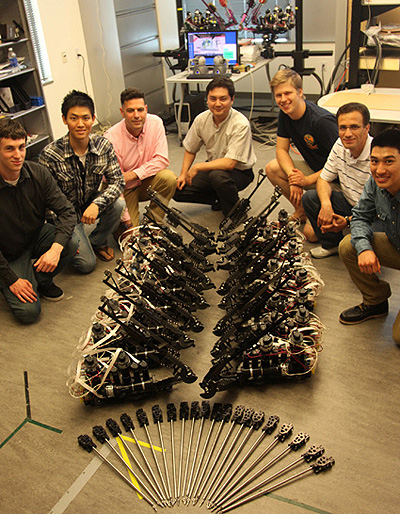
Team members posed with components of the Raven II surgical robotic systems developed in the Bionics Lab at the Baskin School of Engineering. From left to right: Zachary Wells (bioengineering undergraduate), Calvin Yoo (bioengineering undergraduate), lab director Jacob Rosen (associate professor of computer engineering), Ji Ma (postdoctoral researcher), Joshua Schloemer (economics undergraduate), Farhad Ighani (computer engineering undergraduate), and Kyle Fujisawa (computer engineering undergraduate). (Photo by Carolyn Lagattuta)


Robotics experts at UC Santa Cruz and the University of Washington (UW) have completed a set of seven advanced robotic surgery systems for use by major medical research laboratories throughout the United States. After a round of final tests, five of the systems will be shipped to medical robotics researchers at Harvard University, Johns Hopkins University, University of Nebraska, UC Berkeley, and UCLA, while the other two systems will remain at UC Santa Cruz and UW.

"We decided to follow an open-source model, because if all of these labs have a common research platform for doing robotic surgery, the whole field will be able to advance more quickly," said Jacob Rosen, associate professor of computer engineering in the Baskin School of Engineering at UCSC and principal investigator on the project.

Rosen and Blake Hannaford, director of the UW Biorobotics Laboratory, lead the research groups that developed the Raven II robotic surgery system and its predecessor, Raven I. A grant from the National Science Foundation funded their work to create seven identical Raven II systems. Hannaford said the systems will be shipped out from UW by the end of January. After they are delivered and installed, all seven systems will be networked together over the Internet for collaborative experiments.

Robotic surgery has the potential to enable new surgical procedures that are less invasive than existing techniques. For some procedures, such as prostate surgery, the use of surgical robots is already standard practice. In addition, telesurgery, in which the surgeon operates a robotic system from a remote location, offers the potential to provide better access to expert care in remote areas and the developing world. Having a network of laboratories working on a common platform will make it easier for researchers to share software, replicate experiments, and collaborate in other ways.

Even though it meant giving competing laboratories the tools that had taken them years to develop, Rosen and Hannaford decided to share the Raven II because it seemed like the best way to move the field forward. "These are the leading labs in the nation in the field of surgical robotics, and with everyone working on the same platform we can more easily share new developments and innovations," Hannaford said.

According to Rosen, most research on surgical robotics in the United States has focused on developing new software for various commercially available robotic systems. "Academic researchers have had limited access to these proprietary systems. We are changing that by providing high-quality hardware developed within academia. Each lab will start with an identical, fully-operational system, but they can change the hardware and software and share new developments and algorithms, while retaining intellectual property rights for their own innovations," Rosen said.

The Raven II includes a surgical robot with two robotic arms, a camera for viewing the operational field, and a surgeon-interface system for remote operation of the robot. The system is powerful and precise enough to support research on advanced robotic surgery techniques, including online telesurgery.

In addition to Rosen and Hannaford, UCSC postdoctoral researchers Daniel Glozman and Ji Ma, along with a group of dedicated undergraduate students working in Rosen's Bionics Lab, played a key role in developing the Raven II. Rosen and Glozman have also developed a Raven IV surgical robotics system, which includes four robotic arms and two cameras. The system enables collaboration between two surgeons working from separate locations and connected over the Internet.

Source: University of California - Santa Cruz

Send in the Supplies: RoboCopters in Marines’ Future

Engineerblogger
Jan 13, 2012


Marines running low on ammo may one day use an app on their digital handhelds to summon a robotic helicopter to deliver supplies within minutes, enabled by technologies from a new Office of Naval Research (ONR) program.

The Autonomous Aerial Cargo Utility System (AACUS) is a five-year, $98 million effort to develop sensors and control technologies for robotic vertical take-off and landing aircraft.

“AACUS is a leap-ahead technology that allows the Navy and the Marine Corps to move beyond having a highly trained operator fly an unmanned aircraft,” said Rear Adm. Matthew Klunder, chief of naval research. “The program will let us leverage advanced autonomy, but still maintain the central and critical role of the human operator as the supervisor.”

Marines based at outposts or in the field will be able to request the autonomous cargo helicopters for rapid resupply of combat essentials.

“We want to turn any helicopter into a logistics machine,” said Dr. Mary “Missy” Cummings, program officer for AACUS, ONR’s newest innovative naval prototype. “In the near term, we want to succeed in fully-autonomous landings in austere locations, so Marines can get whatever they need on demand.

“In the long term, this could be a real life saver and revolutionize first response,” she added. While rapid resupply is the immediate focus for AACUS, long-term applications could include critical medical missions such as casualty evacuation.

Program officials are seeking researchers who will develop threat- and obstacle-detection and avoidance systems, as well as autonomous landing capabilities that can operate across different types of aircraft. They expect teams from industry and academia to join forces to compete for the contracts.

Proposals are due Feb. 22. Officials plan to award up to two contracts in April.

The effort follows the Marine Corps Warfighting Laboratory’s successful program to develop an unmanned system capable of hauling cargo semi-autonomously to landing zones at bases. The prototype, called K-MAX, flew its first combat mission in Afghanistan in mid-December, resupplying Marines with cargo carried in a sling-load.

AACUS, on the other hand, is aimed at internal load-carrying capacity. It will be a major leap ahead in autonomy, said Cummings. While K-MAX requires a trained operator within line-of-sight to fly, any operator will be able to call for AACUS from any location.

“It’s going to be designed to work with people who have no flight experience,” she said. “An operator will pick up his iPad or Android and make an emergency supply request. He’ll request that the helicopter come to him and land as close to him as possible.”

The helicopter not only will take off by itself, but will plan its own flight path and navigate its way through the airspace, requiring little to no input from an operator other than to verify its proposed landing site. The concept will require improvement in data processing.

“How you take the data from sensors and integrate them to make these decisions—that’s one of the big leaps,” said Cummings. “It’s like putting a frontal lobe on the helicopter.”

For more information on submitting proposals, review the AACUS broad agency announcement (12-004).

Source:  Office of Naval Research 

Related Information:

Tuesday, January 10, 2012

Magnetic Helical Micromachines: Fabrication, Controlled Swimming, and Cargo Transport

Engineerblogger
Jan 10, 2011


A simple and general fabrication method for helical swimming micromachines by direct laser writing and e-beam evaporation is demonstrated. The magnetic helical devices exhibit varying magnetic shape anisotropy, yet always generate corkscrew motion using a rotating magnetic field. They also exhibit good swimming performance and are capable of pick-and-place micromanipulation in 3D. Cytotoxicity of the devices was investigated using mouse myoblasts.

Source:  Wiley Online Library

Additional Information:

Friday, January 6, 2012

Deciphering communication: learning from robots

Engineerblogger
Jan 6, 2012


An experiment led by Laurent Keller at the University of Lausanne (UNIL) and by Steffen Wischmann and Dario Floreano at EPFL shows that communication systems can evolve differently within the same species and even the same environment. Performed using robots, this research can enable a better understanding of communication within the animal kingdom.

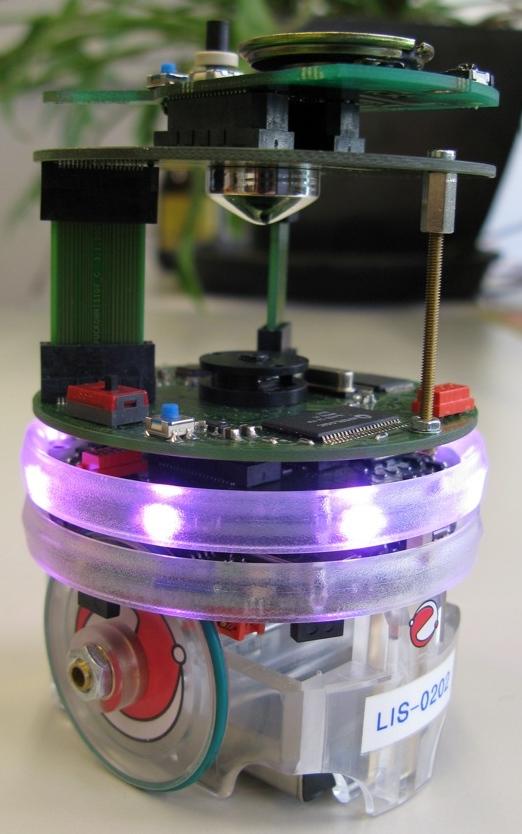
A joint research project conducted at UNIL and EPFL enabled the scientists to follow the evolution of communication in 100 groups of 20 robots over the course of 1000 generations. The robots were equipped with a camera that detected the environment, and also with wheels and a ring enabling them to emit luminous signals of different colors. Positioned in arenas, they had to locate a source of virtual food that was only visible when they came upon it. Their behavior was guided by a “neural network”, which was also controlled by genes that could evolve through mutation and selection in the course of successive generations.

An initial experiment showed that the robots rapidly acquire a communication system that enables them to transmit information about the location of the food to their peers. In fact, two really distinct communication systems evolved, according to the given populations. The simplest mechanism, using a single color to indicate the location of the food, proved more effective that the system using two colors – one pointing towards the food and the other towards the remaining part of the arena.

It also became evident that a population that has evolved towards a relatively effective type of communication doesn’t subsequently change it, as it would then be necessary to simultaneously modify the way the information is transmitted, and also the way of responding. In other words, a communication system, just like a language, cannot change rapidly through generations. In addition, this research underlines the importance of random factors in evolutionary processes. The experiment performed in twenty homogenous groups (with robots of the same type) actually shows that half of them choose the simpler – one color – strategy, whereas the other half opt for the two color system.

Competition requests more complex talking
Finally, a second experiment demonstrated that, even with robots, nothing is perfect. Within a competition context, when groups of robots were confronted with robots of other populations, it was the more complex (two-color) strategy that won the day, in spite of the proven effectiveness of the single-color strategy.

Supported by the Swiss National Science Foundation, this research has been published in the magazine PNAS (Proceedings of the National Academy of Sciences of the United States). It shows that communication strategies can evolve in different ways through generations within an identical environment.

“We know that in the animal kingdom communication systems are very complex”, concludes Laurent Keller, “and this diversity evolved over a very long period of time. Our experiment shows how it occurs, and reveals that environmental factors are not the only ones involved, as one might believe. The robots shed new light on these evolutionary processes.”


Source: École polytechnique fédérale de Lausanne (EPFL)

Additional Information:

Thursday, January 5, 2012

Leaping lizards and dinosaurs inspire robot design

Engineerblogger
Jan 5, 2012


An African Agama lizard swings its tail upward to prevent pitching forward after a slip during take-off. Photo by Robert Full lab, UC Berkeley, courtesy of Nature.

The reseachers at University of California, Berkeley studied how lizards manage to leap successfully even when they slip and stumble. They found that lizards swing their tails upward to prevent them from pitching head-over-heels into a rock.

But after the team added a tail to a robotic car named Tailbot, they discovered that counteracting the effect of a slip is not as simple as throwing your tail in the air. Instead, robots and lizards must actively adjust the angle of their tails just right to remain upright.

“We showed for the first time that lizards swing their tail up or down to counteract the rotation of their body, keeping them stable,” said team leader Robert J. Full, UC Berkeley professor of integrative biology. “Inspiration from lizard tails will likely lead to far more agile search-and-rescue robots, as well as ones having greater capability to more rapidly detect chemical, biological or nuclear hazards.”

Agile therapod dinosaurs like the velociraptor depicted in the movie Jurassic Park may also have used their tails as stabilizers to prevent forward pitch, Full said. Their tail movement is illustrated in a prescient chase sequence from the 1993 movie in which the animated animal leaps from a balcony onto a T. rex skeleton.

“Muscles willing, the dinosaur could be even more effective with a swing of its tail in controlling body attitude than the lizards,” Full said.

Student involvement crucial to research

Full and his laboratory colleagues, including both engineering and biology students, will report their discoveries online on Jan. 5 in advance of publication in the Jan. 12 print edition of the journal Nature. The paper’s first author, mechanical engineering graduate student Thomas Libby, also will report the results on Jan. 7 at the annual meeting of the Society for Integrative and Comparative Biology in Charleston, S.C.

Full is enthusiastic about the interplay fostered at UC Berkeley between biologists and engineers in the Center for Interdisciplinary Bio-inspiration in Education and Research (CiBER) lab, within which he offers a research-based teaching lab that provides dozens of undergraduate students with an opportunity to conduct cutting-edge research in teams with graduate students. Each team experiences the benefits of how biologists and engineers approach a problem.

“Learning in the context of original discovery, finding out something that no one has ever know before, really motivated me,” said former UC Berkeley integrative biology undergraduate Talia Moore, now a graduate student in the Department of Organismic and Evolutionary Biology at Harvard University. “This research-based lab course … showed me how biologists and engineers can work together to benefit both fields.”

“This paper shows that research-based teaching leads to better learning and simultaneously can lead to cutting-edge research,” added Full, who last year briefed the U.S. House of Representative’s Science, Technology, Engineering and Mathematics (STEM) Education Caucus on this topic. “It also shows the competitive advantage of interdisciplinary approaches and how involvement of undergraduates in research can lead to innovation.”

From gecko toe hairs to tails

Full’s research over the past 20 years has revealed how the toe hairs of geckos assist them in climbing smooth vertical surfaces and, more recently, how their tails help to keep them from falling when they slip and to right themselves in mid-air.

The new research tested a 40-year-old hypothesis that the two-legged theropod dinosaurs ‑ the ancestors of birds ‑ used their tails as stabilizers while running or dodging obstacles or predators. In Full’s teaching laboratory, students noticed a lizard’s recovery after slipping during a leap and thought a study of stumbling would be a perfect way to test the value of a tail.

In the CiBER lab, Full and six of his students used high-speed videography and motion capture to record how a red-headed African Agama lizard handled leaps from a platform with different degrees of traction, from slippery to easily-gripped.

They coaxed the lizards to run down a track, vault off a low platform and land on a vertical surface with a shelter on top. When the friction on the platform was reduced, lizards slipped, causing their bodies to potentially spin out of control.

When the researchers saw how the lizard used its tail to counteract the spin, they created a mathematical model as well as Tailbot – a toy car equipped with a tail and small gyroscope to sense body position ‑ to better understand the animal’s skills. With a tail but no feedback from sensors about body position, Tailbot took a nose dive when driven off a ramp, mimicking a lizard’s take-off. When body position was sensed and fed back to the tail motor, however, Tailbot was able to stabilize its body in midair. The actively controlled tail effectively redirected the angular momentum of the body into the tail’s swing, as happens with leaping lizards, Full said.

Inertial assisted robotics

Tailbot’s design pushed the boundaries of control in robotics in an area researchers call inertial assisted robotics, an attention-grabber at last October’s meeting of the International Conference on Intelligent Robots and Systems. The UC Berkeley researchers’ paper, presented by Libby and fellow mechanical engineering graduate student Evan Chang-Siu, was one of five finalists there among more than 2,000 robot studies.

“Engineers quickly understood the value of a tail,” Libby said, noting that when he dropped Tailbot nose-down, it was able to right itself before it had dropped a foot. “Robots are not nearly as agile as animals, so anything that can make a robot more stable is an advancement, which is why this work is so exciting.”

Full and his students are now investigating the role of the tail in controlling pitch, roll and yaw while running.

UC Berkeley coauthors include Full and students Moore, Libby and Chang-Siu, along with Department of Integrative Biology undergraduate Deborah Li and graduate students Ardian Jusufi in the Department of Integrative Biology and Daniel Cohen in the Department of Bioengineering.

The work was funded by the National Science Foundation, including the NSF’s Integrative Graduate Education and Research Traineeship (IGERT) program, and the Micro Autonomous Systems Technologies (MAST) consortium, a large group of researchers funded in part by the U.S. Army Research Laboratory that is focused on creating autonomous sensing robots.


Source: University of California, Berkeley


Wednesday, January 4, 2012

ORNL technology could mean improved prosthesis fitting, design

Engineerblogger
Jan 4, 2012


ORNL biomedical engineers Boyd Evans and John Mueller are working to improve prosthetic fitting and design for young military amputees. (Photo: Jason Richards)

Soldiers returning from war who have lost a leg could lead a more active lifestyle with the help of a technology being developed by Oak Ridge National Laboratory researchers.

ORNL biomedical engineers Boyd Evans and John Mueller are perfecting a portable, wearable system to measure walking patterns that can be applied to real-world activities in a variety of settings.

"For example, if an amputee soldier wants to train and return to active duty, we need to understand how he or she would fare on a military training course, which you can't measure in a laboratory setting," said Evans, who leads the project.

Evans and Mueller are collaborating with Center for the Intrepid at Brooke Army Medical Center to improve prosthesis performance for young soldiers. Wounded soldiers tend to be between ages 18-25, need a prosthetic that will last a long time and are active so they are putting more stress on their healthy limb.

"Lower leg amputees in the military population are typically young, athletic and, besides their injuries, in top physical condition," Mueller said. "For this reason, most military patients want to remain active and in some cases return to active military duty. We are looking at how we can improve prosthesis fit, alignment and function."

Additionally, Evans and Mueller want to develop a gait analysis system that can be utilized outside of a confined laboratory setting. Typically, motion- capture gait analysis is performed in a large, multimillion dollar laboratory using controlled conditions and limited activities.

"The goal of our research is to use the recent advances made in video game technology to develop inexpensive tools for amputee rehabilitation," said Evans. "This will allow advanced rehabilitation techniques to both be used in smaller clinics and to be taken outside the clinic."

To monitor the motion and force of walking patterns, Evans and Mueller are collaborating with BAMC to utilize inertial measurement units and other sensors that can be strapped onto segments of a subject's leg, such as the thigh, calf and foot. The data collected from the IMU transfers to a computer, and algorithms calculate the motions and forces associated with specific joints.

To test the effectiveness of IMUs, Evans and Mueller use a robot leg, which has been programmed with data from a walking person. Evans and Mueller plan on going to the Gait and Motion Analysis Laboratory at Center for the Intrepid in a few months to test their system on a human subject with a prosthetic and healthy leg.

If the prosthesis is not fit or aligned correctly, it could affect a patient's walking patterns, resulting in "asymmetric" gait. These abnormal gait patterns can increase the stress on the healthy limb, leading to problems later in life such as arthritis.

"We have high expectations for this system once it is fully developed," Mueller said. "We think it will improve the prosthetic fitting and aligning process and help lower the risk of chronic joint disease in this group of wounded warriors."

A subset to this overall project, called "Using Kinect for Xbox 360 and Computer Vision to Analyze Human Gait," won the Siemens Competition for Math, Science and Technology in early December. The multi-camera Kinect is connected to a computer that uses body-tracking algorithms to measure how different parts of the leg move when someone's walking. Summer interns Cassee Cain and Ziyuan Liu, who worked with Evans and Mueller, received the top Siemens team award for their project.

Evans and Mueller's work represent an overall collaboration with Otto Bock Healthcare and the Center for the Intrepid at Brooke Army Medical Center. ORNL researcher Randy Lind is developing an advanced platform to measure the forces associated with motion, and researchers Nance Ericson and Ethan Farquhar are integrating the entire system to incorporate wireless data collection.

Source:  Oak Ridge National Laboratory

Tuesday, January 3, 2012

Top articles review of 2011

Engineerblogger
Jan 3, 2012

As we enter a new year, allow me to thank you for your continued support and interest in The Engineering Economist blog this past year—and to take a moment to share some of the best articles of 2011.

  1. Everyday Prothetic Finger 
  2. A new approach to harvesting wave energy   
  3. Boeing funds strategic carbon fibre recycling collaboration 
  4. Technology for Charging The Next-Generation of Environmentally Friendly Vehicles  
  5. Highly efficient oxygen catalyst found could prove useful in rechargeable batteries and hydrogen-fuel production  
  6. First self-powered device with wireless data transmission  
  7. Engineer creates cartilage with 3D printer and living "ink"  
  8. High-quality white light produced by four-color diode laser source  
  9. Solar Ship: The aircraft transport without dependency  
  10. The Energy that Drives the Stars – Different Technologies for Unique Demands  
     
It’s been a great yet humbling year since I started the blog just a year ago. This has enabled me to offer a platform to share with you my daily news review, and to engage and actively contribute views on various technological advances.

I wish you a happy and prosperous 2012.


Tuesday, December 13, 2011

Robotics in Alternative Energy

Robotic Industries Association 
Dec 08 2011

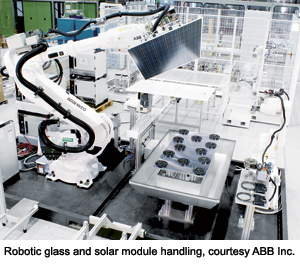
Alternative energy systems, solar photovoltaic panels, wind turbines and fuel cells, continue their rapid technological change. To meet the needs of this swiftly changing market, manufacturers seek out robotics to flexibly keep up with ever-changing products and fabrication processes.

“As the technology evolves, the challenge with alternative energy is the high mix of product that changes rapidly,” says Tim DeRosset, Director of Marketing with the Motoman Robotics Division of Yaskawa America Inc. (Miamisburg, Ohio) “As a new generation of products comes on board, end-users manage robotics to quickly change products and adapt to new technology.”

Seeing the Light
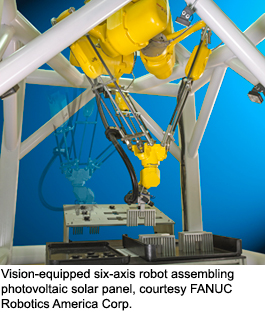
Among the myriad of tasks robots are called on to perform in the alternative energy market, assembling photovoltaic solar panels is one robotics are particularly suited for. “Manufacturers use robots to handle very delicate and thin silicon wafers. The thickness of those wafers continues to be thinner, so become even more delicate over time,” says Chris Blanchette, National Account Distribution Sales Manager with FANUC Robotics America Corp. (Rochester Hills, Michigan) “Robots are used for high-throughput assembly of stringers, a task requiring precision.” When assembling stringers onto panels, robots bond bus wires into electrical connectors.

Rush LaSelle, Vice President and General Manager of Adept Technology Inc. (Pleasanton, California) also says end-users of robotics in the solar industry use robots due to the panels’ delicate nature. “Robots are more consistent and gentle than people when handling wafers and solar cells so robots provide higher throughputs with better yield. Components of thin film solar panels are too big and awkward to be handled by people. In emerging technologies where processes might not be mature, the flexibility of robotics are attractive because they can be retooled or redeployed, whereas hard automation cells are frequently scrapped.”

LaSelle says in high-speed production lines of alternative energy products, manufacturers should recall that the automotive industry has long understood how industrial robots have proven critical assets in improving quality, throughput and managing frequent product changes.

Likewise, DeRosset says, “Alternative energy equipment manufacturing emulates traditional manufacturing. Manufactures of solar panels, wind energy systems and battery manufacturing for electric vehicles use robotics in material handling, assembly and finishing applications for the same reasons as traditional manufacturers: cost and flexibility.”

Jordan Merhib, Business Development Director of Applied Manufacturing Technologies Inc. (AMT, Orion, Michigan) has a similar take on the role of robotics in alternative energy equipment production. “Companies manufacturing solar panels are still making product design changes. Manufacturing systems must accommodate future product designs. Hard automation is more difficult and expensive to upgrade.”

 Continuing, Merhib says, “Solar products do not always require traditional material handling, but are created by depositing photo-electric materials onto sheets. That application is more of a fluid deposition process than material handling or pick and place.”

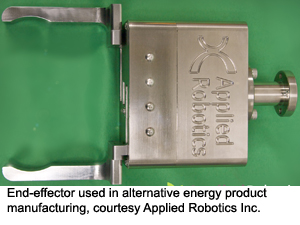
Merhib speaks of dexterous end-effectors necessary to successfully manipulate thin silicon wafers during fabrication. “Vacuum tools used to handle delicate solar wafers are done in a way that the part does not come into contact with the end-effector but puts a blanket of air between the part and the tooling. Other technologies such as servo controls slow the end-effector down before actually engaging the part.” Merhib says materials used in the end-effector’s construction should not affect the surface of the part the gripper is handling.

David Walter, Applied Robotics Inc.’s (Glenville, New York) Engineering Manager, also thinks about the delicate nature of solar power equipment and specialized grippers required to meet high throughput needs of wafer fabrication. “The manufacture of alternative energy systems requires specialized end-effectors. An international solar energy company we worked with broke more parabola-shaped glass bowls than they were creating. Most grippers are not able to handle fragile glass objects at high speeds.” The concave collector and distributor of solar energy were dropped or being squeezed to their breaking point, Walter said. That problem was addressed using flexible robotics in conjunction with a dexterous end-effector.

Charles Miller, ABB Inc.’s (Auburn Hills, Michigan) Northern Region Vice President of Sales agrees end-effectors handling silicon wafers must move both quickly and gently. “Cutting wafers thinner requires specialized end-effectors to prevent breakage at very high speeds. Wafers are very fragile and brittle so must be carefully supported throughout the whole range of motion. Wafers could break when picked up or set down and become little airfoils when moved at high velocities.”


Accurate placement of solar panel components is critical, says Miller. “In solar panel manufacturing, accurate placement comes into play in more densely populated solar panel work cells. Robots are soldering and brazing as well as dispensing tape when putting multiple panels together.” After the robot dispenses the tape, it performs a trimming task.
To read more click here...

Thursday, December 8, 2011

Exploring Earth's atmosphere using the world’s first fully ‘rapid prototyped’ air vehicle

Engineerblogger
Dec 8, 2011


The ASTRA Atom

Engineering scientists at the University of Southampton are flying the world’s first fully rapid prototyped air vehicle this week, to help develop new technologies that probe the Earth's atmosphere using an unmanned platform.

The vehicle is part of the Atmospheric Science Through Robotic Aircraft (ASTRA) project, and it aims to demonstrate how a low-cost, bespoke high altitude platform could be developed and manufactured over a period of mere days and used to send a payload with atmospheric monitoring equipment into the upper atmosphere.

The entire structure of the balloon-borne pod – dubbed the ASTRA Atom -- has been printed, and the on-board data logging equipment has been built using Microsoft's rapid electronic prototyping toolkit .NET Gadgeteer. The Atom was printed on the University’s 3Dprinter, which fabricates plastic objects, building up the item layer by layer.

The aircraft is protected by two foam ‘orbits’, manufactured using a computer-controlled hot wire cutter at the University’s Engineering Design and Manufacturing Centre, which are designed to break on landing and absorb the energy of the impact.

Dr András Sóbester, University of Southampton Lecturer and a Royal Academy of Engineering Research Fellow, says: “The rapid prototyping of bespoke platforms like the ASTRA Atom enables scientists to deliver a variety of instruments far into the stratosphere after a very short design and manufacture cycle. This may be required for testing purposes, as part of an iterative development process or there may be a sudden need to make observations of phenomena such as volcano eruptions or nuclear fallout. In such cases, rapid prototyping translates into fast response and timely measurements that could not be obtained in other ways.”

Dr Steven Johnston, from the University of Southampton’s Microsoft Institute of High Performance Computing, adds: “The challenges of developing such systems are varied as the aircraft has to be able to operate in the harsh, low pressure, low density environment of the upper stratosphere, as well as in the dense and turbulent lower troposphere. Additionally, weight and power requirements of all on-board systems have to be minimised. The need to keep weight and cost to a minimum, while providing bespoke architectures demands novel manufacturing technologies, such as 3D printing, too.

“Using conventional materials and manufacturing techniques, such as composites, developing such platforms would normally take months. Furthermore, because no tooling is required for manufacture, radical changes to the shape and scale of the ‘pod’ can be made with no extra cost.”

The ASTRA aircraft will have its maiden flight Wednesday 07 December at Microsoft Research’s 8th annual Think Computer Science event at The Imperial War Museum in Duxford. The event is a unique opportunity for year 8 and 9 students to gain an insight into the work of scientists and view a selection of the latest technologies in development through presentations and interactive demos.

Source:  University of Southampton

Additional Information:

The ROBOCAST Project: Robotic system for assisting neurosurgery

Engineerblogger
Dec 8, 2011


Robocast Plan. Credit: Robocast

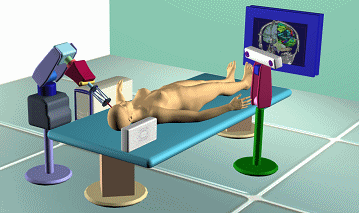
 The ROBOCAST project focuses on robot assisted keyhole neurosurgery. This term refers to a brain surgery performed through a very small hole in the skull called burr hole. The reduced dimensions are the reason why it is called also “keyhole”.This surgery is carried out for several interventions, from endoscopy to biopsy and deep brain stimulation. Needles and catheters are inserted into the brain through the tiny hole for biopsy and therapy, including, among others the tasks of blood/fluid sampling, tissue biopsy, cryogenic and electrolytic ablation, brachytherapy, deep brain stimulation (DBS), diagnostic imaging, and a number of other minimally invasive surgical procedures. Related pathologies are tumours, hydrocephalus, dystonia, essential tremor, Parkinson’s Disease, Tourette Syndrome, clinical depression, phantom limb pain, cluster headache and epilepsy.

The ROBOCAST project outcome will be a system for the assistance of the surgeon during keyhole interventions on the brain. It will have a mechatronic part and an intelligence part. The mechatronic device will consist of a robot holding the instruments for the surgeon and inserting them in the brain with a smooth and precise controlled autonomous movement. The trajectory will be defined by the intelligence of the ROBOCAST system and will be approved by the surgeon, which is and remains the responsible of the outcome, before the insertion of the surgical instruments.

Source: Robocast

Additional Information:

Tuesday, December 6, 2011

Robots will soon appear in school classrooms

Engineerblogger
Dec 06, 2011


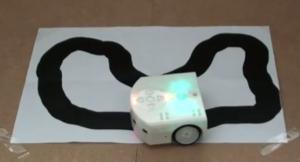
Thymio II. Credit: EPFL


EPFL scientists have developed an educational robot designed to introduce children to technology in schools. Baptized Thymio II, it was officially presented to teachers in the Canton of Vaud last friday.

Creating an original pedagogical tool to get students interested in technology and robotics: this is the challenge that was undertaken by a group of the researchers led by Fancesco Mondada, in EPFL’s Robotics Systems Laboratory. In collaboration with the University of Art and Design Lausanne (ECAL), they developed Thymio II, a little programmable white robot, jam-packed with sensors and LEDs, that can exhibit a wide range of behaviours. “We worked really hard on the hardware,” Mondada explains. “Each sensor is associated with a coloured LED, which allows the kids to visualize the activation of the sensors during a specific manoeuver.” The Thymio II robots, which made their debut in May during EPFL’s robotics festival, has been presented to teachers on November 25, as part of a course organized by the cantonal teacher’s college (HEP).

Explorer, coward, investigator, friend
The 11 cm x 11 cm robot is equipped with proximity sensors (it can detect close objects), ground-directed sensors (it can detect the edge of a table around which it’s circulating, or a line to follow), accelerometers (It can measure acceleration, detect impacts and indicate gravity), a microphone and a temperature sensor (an electronic thermometer). It also has a memory card for recording sound. After they’ve turned their Thymio II on using buttons on the surface, users get the robot to adopt one of the basic modes, such as friend (follows an object in front of it), explorer (avoids obstacles), coward (detects impacts and empty space) or investigator (follows a line on the ground).
By hooking it up to a computer via a USB cable, users can invent and program other behaviours. “You could imagine the robot becoming blue when you put it in the fridge, for example,” suggests Mondada. The programming is done using a software called Aseba, which was developed by EPFL. “Aseba is a simple language, but it contains the principle concepts of programming,” Mondada continues. The software code is “open source,” available for modification or downloading over the Internet, and rights free.


Credit: EPFL

 From Lego to programming, by way of physics
Thymio II is not just a teaching tool for robotics professors. Thanks to its many sensors, it can also be used to teach physics, when subjects such as gravity, the properties of light and temperature are on the agenda. And thanks to its engaging character, the robot can also be used by children who are too young to understand programming. “It’s possible to stack Lego bricks on top of the Thymio II. Kids can decorate it and play with it to start with, then discover new kinds of behaviour over the Internet, and start to program it when they’ve gotten a bit older.”

Will Thymio II be a hit in the schools? Philippe Krähenbuhl , a science and robotics teacher at the Collège du Vevey, is enthusiastic. “Thymio II is inexpensive (about 99 francs), accessible, and very complete. It leaves room for creativity,” he says. “I appreciate the fact that you can use it in different ways, whether for building with legos, for teaching physics or for teaching programming skills.” For his part, Mondada says he welcomes suggestions from teachers, in order to improve the small white robot even further.

Source:  École polytechnique fédérale de Lausanne (EPFL)

Monday, December 5, 2011

ONR Helps Undersea Robots Get the Big Picture

Engineerblogger
Dec 05, 2011
 
The Office of Naval Research conducts Autonomous Underwater Vehicle operations aboard the USNS Sioux off of San Clemente Island in the Pacific Ocean in September 2010. Recently ONR-sponsored scientists completed sea tests of new control software that makes underwater robotic vehicles smarter at autonomously surveying large swaths of ocean. Credit: US Navy photo by John F. Williams/Released


Scientists have successfully transitioned fundamental research in autonomy to undersea gliders, demonstrating in recent sea tests how the new software, sponsored by the Office of Naval Research (ONR), can help robots become smarter at surveying large swaths of ocean.

“Using the new algorithms, the vehicle has a greater ability to make its own decisions without requiring a human in the loop,” said Marc Steinberg, program officer for ONR’s Adaptive Networks for Threat and Intrusion Detection or Termination (ANTIDOTE), a multi-disciplinary university research program.

With plans to deploy squadrons of air, surface and undersea robotic vehicles later this decade, the Department of the Navy is investing in basic research programs to improve autonomous system capabilities.

“Advancing autonomy for unmanned systems allows you the ability to do things that wouldn’t be practical otherwise because we don’t have enough warfighters or communication today,” said Steinberg, who works in ONR’s Naval Air Warfare and Weapons Department. “If you incorporate some intelligence on the vehicles that can solve complex mission problems, then we can enable wholly new capabilities that can be achieved with limited numbers of people and communications in complicated, dynamic environments.”

ONR provided funding to researchers at the Massachusetts Institute of Technology (MIT) and University of Southern California (USC) to advance the intelligence of autonomous vehicles under both ANTIDOTE and a related university program called Smart Adaptive Reliable Teams for Persistent Surveillance. They developed a persistent surveillance theory that provides a framework for decision-making software that maximizes a robot’s collection of information over a given area. It gives some guarantees on performance in dynamic environments.

“The ability to do surveillance that takes into account the actual conditions of the environment brings a whole new level of automation and capability,” said Dr. Daniela Rus, co-director of MIT’s Computer Science and Artificial Intelligence Laboratory Center for Robotics. “We have come up with a solution that lets the robot do local reasoning to make decisions and adjust the path autonomously without having to come up to the surface to interact with humans.”

The scientists produced an algorithm that incorporates both the user’s sensing priorities and environmental factors, such as ocean currents, into a computer model to help undersea robots conduct surveys and mapping missions more efficiently.

Tests proved the benefits of using the new algorithm. The scientists conducted two separate experiments using underwater robots called gliders, operated by oceanographers. They used two gliders, one with the algorithm and one without, to measure whether the experimental technology yielded better maps of algae blooms and other underwater phenomena in the Pacific Ocean.

“In areas where the oceanographers wanted more information, the persistent surveillance algorithm actually produces more detail,” said Dr. Gaurav S. Sukhatme, ANTIDOTE’s principal investigator and director of USC’s Robotic Embedded Systems Lab. “The system can automatically figure out how to divide its time between areas that are more interesting and areas that are less interesting.”

The algorithm helps the gliders decide when to spend more time looking at regions that have changes in activity or environmental factors. Without the control algorithm, gliders paid equal attention to all areas and acquired less information during the experiments in Monterey Bay, Calif., and along the southern coastal waters near Los Angeles in October and November 2010. The first experiment lasted a period of three weeks; the second ran for two weeks. A third experiment in August 2011 took place in the Southern California Bight for 10 days. Results of the single-glider test are being analyzed.

Though the gliders were an ideal first test of the persistent surveillance theory and algorithm, the software is applicable to many different machines and robots, the scientists said.

Source:  Office of Naval Research

Robotic Companions for Older People

Engineerblogger
Dec 05, 2011
 
Credit: University of Hertfordshire

Dr Farshid Amirabdollahian, a senior lecturer in Adaptive Systems and expert in Rehabilitation Robotics and Assistive Technologies at the University is coordinating a new FP7 European project called ACCOMPANY – Acceptable Robotics Companions for Ageing Years – which will develop a robot to assist with everyday tasks in the home. The principal investigator for this project is Professor Kerstin Dautenhahn who has a substantial track record in human-robot interaction studies and companion robots.

Over the three-year period of the project, the researchers will carry out research in the University’s Robot House. They will use a Care-o-bot® 3 to carry out a wide range of studies with older people to assess their requirements and acceptance of the robot as part of an intelligent home environment. Results will then be fed back to adapt the technology so that it better suits user demands and preferences.

“The envisaged relationship between the user and the robot is that of co-learner, whereby the robot and user provide mutual assistance and so that the user is not dominated by technology, but feels empowered by it,” said Dr Amirabdollahian. “Our aim is to use the robot to increase independence and quality of life.”


The research of the UH team in ACCOMPANY will be based on results from the FP7 project LIREC which has studied since 2008 the development of robots as home assistance for a general user group. In contrast, ACCOMPANY will focus on the specific user group of elderly people.

Other project partners are: Hogeschool Zuyd, Fraunhofer, University of Amsterdam, University of Sienna, MADoPA - a French expert centre and University of Birmingham.

ACCOMPANY is a €4,825,492 FP7 European project. It began last month and is due to end by September 30 2014. The project is partially funded by the European Commission under the Seventh (FP7 - 2007-2013) Framework Programme for Research and Technological Development.

Source:  University of Hertfordshire

Monday, November 28, 2011

Everyday Prothetic Finger

Engineerblogger
Nov 28, 2011


X-Fingers surgical steel fingers.


In a former life, Dan Didrick fabricated cosmetic fingers. The key word in that phrase is cosmetic.

“The fingers were only a silicon cap that doesn’t bend,” Didrick said. “We call them Sunday fingers because you wear them to church or dinner and then throw them in a drawer for the week.”

Bedeviled by the cosmetic fingers’ shortcomings, he invented X-Finger, surgical steel fingers that move, flex, and grasp, just like the wearer’s original fingers.

“You can move them as quickly as you can move your prior finger; plus because it’s common to flex your finger from open to closed and the X Finger follows motion of a residual finger, there’s no learning curve,” Didrick said. “A patient can use the device right away after putting it on. They could immediately catch a tossed ball that they see from the corner of their eye.”


Along the 10-year path since his first prototype, Didrick patented the device—which uses no electronics—himself, sought and received coverage from all major medical insurers for the fingers, and taught himself computer-aided design (CAD). That last bit, he said, was the easiest.

A huge proportion of nonfatal accidental amputations involve fingers. The U.S. Bureau of Labor Statistics estimates that finger losses account for about 94 % of job-related amputations.

So Didrick—who got his start in prosthethics as a child, by using materials from his father’s dental office to make movie-quality monster masks—put his skills to use fabricating prosthetic fingers.


But his world, and his job, changed when he met a man who had lost several fingers in an accident and who was deaf. The loss of the fingers made it impossible to communicate in sign language.

“I started by actually carving components out of wood and assembling them into reciprocating series of components that, through leverages, force the mechanics in the shape of a finger to move from a straight to a bent position; from straight to a fist,” Didrick said.

Many amputees retain part of their finger. So the device, when fitted over the hand and the residual finger or fingers, lets a patient move his or her X-Finger by moving the residual finger from extended to bent.


X-Fingers, invented by Dan Didrick, are prosthetic fingers that can be manipulated by wearers through use of their residual finger or fingers. The device lets them regain full use of their finger or fingers.

“So I came up with the assembly, but I was just carving them out of wood,” Didrick said. “Then I started seeking out design engineers. That’s when I realized it can cost tens of thousands of dollars to have a design engineer create an assembly of this nature.”

Though he had majored in business in college, Didrick rose to this first challenge as he would rise to many others while launching X-Finger. He simply bought a CAD package—SolidWorks, from the company in Concord, MA—and quickly ran through the tutorial.

“Then I just started designing the components,” he said. “It only took about two weeks to get the first design. I shipped those to a manufacturer and they replicated them using an EDM machine and sent back components.”

Because all amputation cases are different, Didrick went on to develop what he called an erector set of parts that could be assembled into more than 500 different configurations. That number is likely much higher than 500, but “once I got that high, I became confused counting them,” he said.

The device is composed of stainless steel, with a plastic cap that sits on the tip of the finger and another bit of plastic that sits at the flange. This is covered with a thermoplastic cosmetic skin that is soft and resists tearing. Think of what an artificial fishing worm feels like and how it can stretch.

“We actually contacted a company that was doing a job for the military, and they’d formulated thermoplastic to the same durometer reading as human skin; so it’s almost eerie to touch it, in that it feels like skin,” Didrick said.

Each finger contains 23 moving parts, though depending on the complexity of the case—such as whether the wearer retains a residual finger or not—it could contain more. For those without residual fingers, a wire runs into the webbing between the fingers to receive open and flex impulses. The device is attached to the wrist and fitted over the hand and the residual fingers.

“It was really challenging replacing the ring and middle finger. The joint that controls those residual fingers is in your hand,” Didrick said. “But in this case it needs a probe that goes down into the webbing between the fingers to be controlled by that joint.

For those who have lost four fingers, the device allows the movement of the palm to control all the artificial fingers.

Post Engineering

Though he’d invented the world’s first active prosthetic finger (the passive type is the cosmetic ‘Sunday’ finger), Didrick, who now owns Didrick Medical of Naples, FL, was still an industry outsider.

He bought a book called Patent It Yourself by David Pressman (1979 McGraw-Hill and since updated) and spent a year writing his own patent.

Once the device was patented, FDA representatives and some online help taught him how to write a 513(d) document necessary for device evaluation. Didrick sent his evaluation to the agency and soon received a positive response. X-Fingers (the plural, used when the device contains more than one finger) had been registered with the FDA.

The next step was receiving insurance approval for the fingers. After he won approval from the FDA, he went on to get approval from all major insurance companies, which now cover X-Fingers.

“From there, the device began taking off. The need was great,” Didrick said. “Many amputees had been awaiting something like this.”

What’s little realized, he said, is how many children lose fingers. The largest group of people who lose fingers outside the workplace are children under five, who undergo finger amputation due to accidents like slamming them in a car door.

He also has learned that one out of 200 people will lose one or more fingers within their lifetime. That statistic takes into account people living all over the world.

“It’s not only machinists who lose fingers,” Didrick said.

Because his device is powered by the body, literally the wearer is flexing and bending his hand.

Many of Didrick’s customers pay a deposit in advance, which helps finance the four-employee company and it’s continued innovations.

What’s New and Next?

After his initial success, Didrick began routinely traveling to the Brooke Army Medical Center in San Antonio and to the Walter Reed Army Medical Center in Washington, DC, to fit wounded soldiers. He has also has fitted British soldiers with the device.

The U.S. Department of Defense asked him to design an artificial thumb, which he has also done. It’s not surprisingly called the X-Thumb.

He’s now at work on a thin glove that would enable those with paralyzed hands who retain some mobility in the wrist to use that mobility to control their hands.

Didrick is also trying to help children whose insurance companies deny them coverage because they grow out of their prosthetics too fast. The costs of producing children’s X-Fingers are high because of the variation in injuries and finger dimensions in smaller fingers and hands. He’s recently established the nonprofit 501(c)(3) organization, World Hand Foundation, to cover costs to provide X-Fingers for those who cannot afford to pay for them.

And he’s still using his original CAD package.

“If we needed the funds to hire a professional design team we’d never be able to do this,” Didrick said.

Source: ASME

Robots in reality: Robots for real-world challenges

MIT News
Nov 28, 2011

Nicholas Roy, an MIT associate professor of aeronautics and astronautics
Photo: Dominick Reuter

Consider the following scenario: A scout surveys a high-rise building that’s been crippled by an earthquake, trapping workers inside. After looking for a point of entry, the scout carefully navigates through a small opening. An officer radios in, “Go look down that corridor and tell me what you see.” The scout steers through smoke and rubble, avoiding obstacles and finding two trapped people, reporting their location via live video. A SWAT team is then sent to lead the workers safely out of the building.

Despite its heroics, though, the scout is impervious to thanks. It just sets its sights on the next mission, like any robot would do.

In the not-too-distant future, such robotics-driven missions will be a routine part of disaster response, predicts Nicholas Roy, an MIT associate professor of aeronautics and astronautics. From Roy’s perspective, robots are ideal for dangerous and covert tasks, such as navigating nuclear disasters or spying on enemy camps. They can be small and resilient — but more importantly, they can save valuable manpower.

The key hurdle to such a scenario is robotic intelligence: Flying through unfamiliar territory while avoiding obstacles is an incredibly complex computational task. Understanding verbal commands in natural language is even trickier.

Both challenges are major objectives in Roy’s research — and with both, he aims to design machine-learning systems that can navigate the noise and uncertainty of the real world. He and a team of students in the Robust Robotics Group, in MIT’s Computer Science and Artificial Intelligence Laboratory (CSAIL), are designing robotic systems that “do more things intelligently by themselves,” as he puts it.

For instance, the team is building micro-aerial vehicles (MAVs), about the size of a small briefcase, that navigate independently, without the help of a global positioning system (GPS). Most drones depend on GPS to get around, which limits the areas they can cover. In contrast, Roy and his students are outfitting quadrotors — MAVs propelled by four mini-chopper blades — with sensors and sensor processing, to orient themselves without relying on GPS data.

“You can’t fly indoors or quickly between buildings, or under forest canopies stealthily if you rely on GPS,” Roy says. “But if you put sensors onboard, like laser range finders and cameras, then the vehicle can sense the environment, it can avoid obstacles, it can track its own position relative to landmarks it can see, and it can just do more stuff.”
To read more click here...

Thursday, November 24, 2011

Insect cyborgs may become first responders, search and monitor hazardous environment

Engineerblogger
Nov 24, 2011


Credit: Image courtesy of University of Michigan


Research conducted at the University of Michigan College of Engineering may lead to the use of insects to monitor hazardous situations before sending in humans.

Professor Khalil Najafi, the chair of electrical and computer engineering, and doctoral student Erkan Aktakka are finding ways to harvest energy from insects, and take the utility of the miniature cyborgs to the next level.

"Through energy scavenging, we could potentially power cameras, microphones and other sensors and communications equipment that an insect could carry aboard a tiny backpack," Najafi said. "We could then send these 'bugged' bugs into dangerous or enclosed environments where we would not want humans to go."

The principal idea is to harvest the insect's biological energy from either its body heat or movements. The device converts the kinetic energy from wing movements of the insect into electricity, thus prolonging the battery life. The battery can be used to power small sensors implanted on the insect (such as a small camera, a microphone or a gas sensor) in order to gather vital information from hazardous environments.

A spiral piezoelectric generator was designed to maximize the power output by employing a compliant structure in a limited area. The technology developed to fabricate this prototype includes a process to machine high-aspect ratio devices from bulk piezoelectric substrates with minimum damage to the material using a femtosecond laser.

In a paper called "Energy scavenging from insect flight" (recently published in the Journal of Micromechanics and Microengineering), the team describes several techniques to scavenge energy from wing motion and presents data on measured power from beetles.

This research was funded by the Hybrid Insect Micro Electromechanical Systems program of the Defense Advanced Research Projects Agency under grant No. N66001-07-1-2006. The facilities used for this research include U-M's Lurie Nanofabrication Facility.

The university is pursuing patent protection for the intellectual property, and is seeking commercialization partners to help bring the technology to market.

Source: University of Michigan


Wednesday, November 16, 2011

Robotics in Security and Military Applications

Robotics Online
Nov 14, 2011


Robotics have been a staple of advanced manufacturing for over half a century. As robots and their peripheral equipment become more sophisticated, reliable and miniaturized, these systems are increasingly being utilized for military and law enforcement purposes.

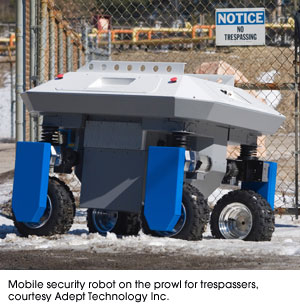
“Military and battlefield applications continue to grow at an accelerated pace due to demand fueled by government investment. Over the past decade, we have seen increasing levels of investment in autonomous vehicles used for surveillance and security,” says Rush LaSelle, Vice President and General Manager with Adept Technology Inc. (Pleasanton, California) “Applications range from monitoring perimeters of secured areas such as airports to acting as a night watchman.”

Robots go to War

Mobile robotics play an increasingly important role in military matters, from patrol to dealing with potential explosives. “With suitable sensors and cameras to perform different missions, mobile robots are operated remotely for reconnaissance patrol and relay back video images to an operator,” says Dr. Andrew Goldenberg, PhD, Chief Executive Officer and President of Engineering Services Inc. (ESI, Toronto Ontario, Canada) “Robots can neutralize suspicious objects that may explode. The platform has a robot arm to pick up explosives or suspected hazards in military or civilian settings.”

Goldenberg goes on to say, “The mobile robotic platform is mounted on a rectangular box with electronic equipment. The platform moves on wheels or tracks, or both, and is usually battery-powered. Communication equipment and sensors can detect images, sounds, gases and other hazards. The communication systems read sensors and relay that information to the operator.”

According to Goldenberg, the United States military recently began equipping mobile robotic platforms to carry small and medium-size firearms.

Robotics help meet challenges posed by the specter of urban terrorism. “Instead of having people get close to hazards such as unattended objects or car bombs, robots are used. If an operator concludes a dangerous object might explode, the robot could neutralize that object by shooting to detonate it,” Goldenberg says. “Mobile robots detect and explode in-ground mines or improvised explosive devices.” These same mobile robotic systems are used for neutralizing or exploding forgotten ordnance and mines after conflicts cease.

Likewise, LaSelle says, “Government acts as a catalyst for these applications due to the heavy investment after the terrorist attacks of September 11, 2001. Security and patrol functionalities have extended into the private sector. Companies invest in autonomous vehicles to monitor warehouses, factories, and office spaces. These sentinel applications provide users with the ability to monitor a variety of conditions such as motion, intrusion, water ingress, and temperature.”

Keeping tabs on temperature is of special importance to server farms and other sensitive electronic systems, LaSelle says. “A key area of activity for mobile robotic platforms is patrolling vacant properties and warehouses due to the reliability and low costs attributed to autonomous vehicles,” adds LaSelle.

Goldenberg’s and LaSelle’s portrayals of tasks carried out by mobile robotic platforms is echoed by Sean Thompson, Applications Engineer with MICROMO. (Clearwater, Florida) “Ground-based systems use robotics for surveillance. These platforms are equipped with weapons and cameras.” Thompson dubs some reconnaissance robots as “throw-bots,” saying these systems are “Small and light robots, robust enough to throw through a window or doorway. The robot is equipped with a camera to see within a building without sending in people.” If the structure is without light, the mobile platform’s camera is equipped with infrared or night vision, Thompson says. Another less conventional robotic application is a small reconnaissance aircraft transported by backpack. “A soldier throws small reconnaissance aircraft into the air which takes off and recover themselves.”

Additionally, Thompson says mobile robotics assist military personnel transport equipment in the field. “In military applications, wearable robotics help soldiers carry a heavy pack load. A robot acts like a pack mule, is fully autonomous, and carries a large amount of supplies.”

Thompson speaks of robotics to help inspect and maintain nuclear weapons. “Mobile robotic systems inspect nuclear missiles. Commonly, such inspection systems were large, requiring several people in protective suits going into containment systems. Now, smaller self-guided robotic systems require only one person in a protective suit going to a certain point and letting the robot go.” The robot is remotely operated outside the containment system, reducing the number of people and the amount of time people are exposed to relatively high radiation levels, Thompson concludes.
To read more click here...


This Is What DARPA's Robot Ostrich Will Look Like

Engineerblogger
Nov 15, 2011


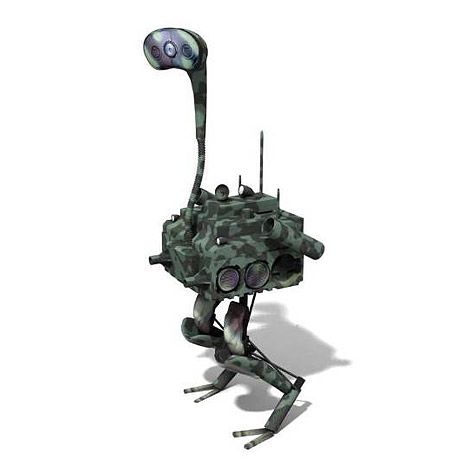
I'll bet you didn't know that DARPA was even interested in a robotic ostrich, did you? I sure as heck didn't. But I suppose it shouldn't be that surprising, since DARPA seems to want robotic versions of just about anything that's capable of extreme levels of performance, and an ostrich apparently fits the, uh, bill.

The above image is a rendering of the eventual form of a robot called FastRunner, a project led by the Florida Institute for Human and Machine Cognition (IHMC), in Pensacola. MIT's Robot Locomotion Group is a partner in the project. FastRunner uses a novel* leg design that should allow it to efficiently sprint at speeds of over 30 kilometers per hour while stabilizing itself and only using one actuator per leg. It'll also be able to run over moderately rough terrain, albeit at 15 km/h, which is still probably going to give even a talented human a run for their money. To put the speed of this robot in perspective, a human can sprint at about 40 km/h over short, level distances, while an actual ostrich can hit almost 100 km/h, with sustained speeds in the 70s.

So far, FastRunner consists of legs and body in simulation, plus one full-scale test leg. When completed, the robot will weigh about 30 kilograms, stand 1.4 meters high, and offer fast, efficient, and very robust motion for whatever potentially sinister applications DARPA can dream up:

IHMC has a lot of experience building legged robots. Researchers there have focused on "biologically inspired hardware design, bipedal and quadrupedal walking, balance, and push-recovery control," among other things. They've written locomotion algorithms for the LittleDog program, another DARPA initiative, and they're also developing humanoid robots for operation in urban environments and robotic exoskeletons to assist people with limited mobility.

MIT, for their part, has a whole bunch of experience with making clever robots with legs. In fact, they have (or had, at any rate) a whole lab dedicated to it. Fans of cool robots might remember this Thanksgiving-themed post from 2008, showing a robotic turkey, chicken, and dinosaur walking around MIT back in 2001. Ostriches are functionally very similar to dinosaurs and their descendants (I'm talking about birds, of course), perhaps even more so since the noble ostrich doesn't rely on its wings for much more than providing shade for smaller ostriches.

Anyway, getting back to FastRunner, it's pretty clear that these researchers have a solid foundation for the design of this robot, especially if you think about where they were 10 years ago and all the technological wonderment that's happened between then and now. My only remaining question is this: Those tubes on the sides of the robot in the rendering... Rocket launchers, or turbojets?


Source: Spectrum IEEE

Watch This Robot Control a Person's Arm Using Electrodes

Spectrum.ieee.org
Nov 15, 2011


When this robot needs a hand, it borrows yours.


In an experiment that opens a new chapter in human-machine interaction, a French research team has demonstrated how a robot can control both its own arm and a person’s arm to manipulate objects in a collaborative manner.

The robot controls the human limb by sending small electrical currents to electrodes taped to the person's forearm and biceps, which allows it to command the elbow and hand to move. In the experiment, the person holds a ball, and the robot a hoop; the robot, a small humanoid, has to coordinate the movement of both arms to successfully drop the ball through the hoop.

The researchers, from the Montpellier Laboratory of Informatics, Robotics, and Microelectronics (known by its French acronym LIRMM), say the approach is still in the proof-of-concept stage, but they are confident that performing more complex tasks is possible. Their goal is to develop robotic technologies that can help people suffering from paralysis and other disabilities to regain some of their motor skills.

To be sure, an advanced, dexterous robot arm would be capable of assisting paralyzed people with daily tasks. And other technologies such as robot teleoperation, brain-machine interfaces, and powered exoskeletons also promise to give physically disabled people more mobility.

But Adorno and his colleagues say there are advantages in having a robot controlling a person's body. The technique they're using to do that, known as functional electrical stimulation (FES), is used in rehabilitation and has physical and psychological benefits to patients.

"Imagine a robot that brings a glass of water to a person with limited movements," says Bruno Vilhena Adorno, the study's lead researcher. "From a medical point of view, you might want to encourage the person to move more, and that's when the robot can help, by moving the person's arm to reach and hold the glass."

Another advantage, he adds, is that capable robotic arms are still big, heavy, and expensive. By relying on a person's physical abilities, robotic arms designed to assist people can have their complexity and cost reduced. Many research teams are teaching robots how to perform bimanual manipulations, and Adorno says it seemed like a natural step to bring human arms into the mix.
To read more click here...